
Understanding Supplier Prioritization in Direct-to-Consumer Businesses
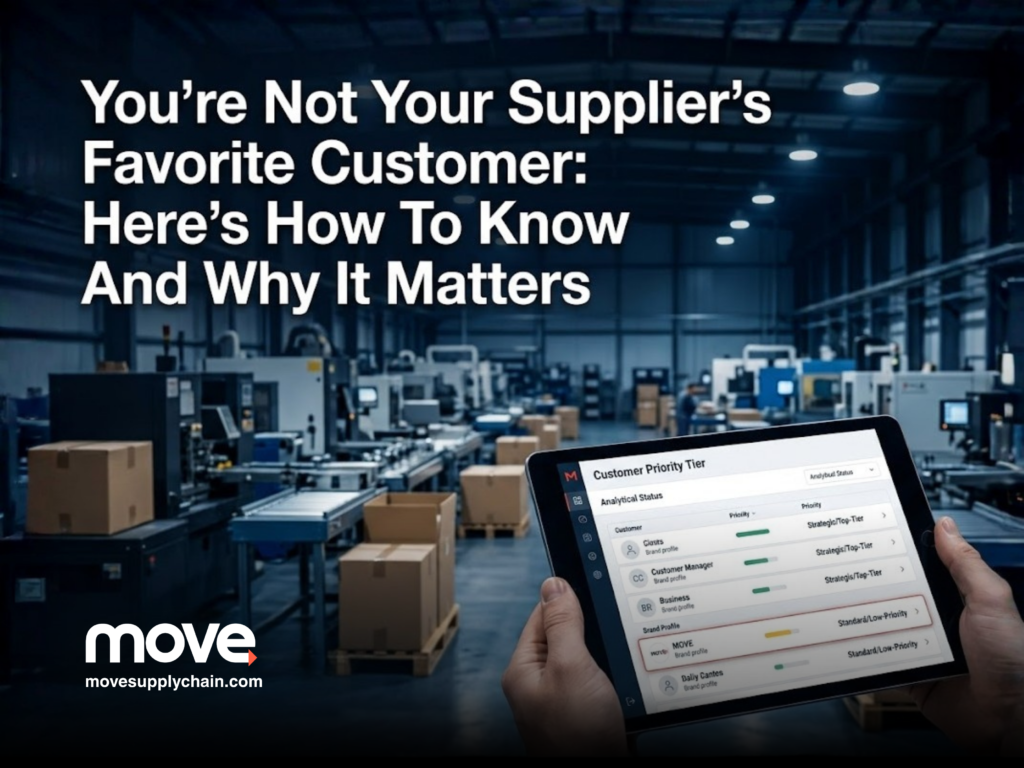
Here’s a truth that stings: You’re probably not your supplier’s favorite customer.
I know—you’re the one placing orders. You’re writing the checks. You’re the customer. Doesn’t that mean something?
In theory, yes. In practice, suppliers don’t prioritize based on who pays. They prioritize based on who pays consistently, orders predictably, and doesn’t create chaos.
In 17 years of supply chain—from enterprise to DTC—I’ve watched brands assume they had leverage, only to discover they ranked somewhere between “tolerated” and “we’ll get to them eventually.”
The power dynamic in supplier relationships matters more than most founders realize. And understanding where you actually stand is the first step toward improving that position.
The Asymmetry You’ve Never Considered
Let’s start with a simple reality check:
Your supplier has 50 customers. You have 1 supplier (for that product).
Of those 50 customers, some order $500K per year. Some order $50K. Some pay in 15 days. Some pay in 90. Some are predictable planners. Some are chaos machines who change specs mid-production.
You’re one name on that list. And whether you realize it or not, there’s an invisible ranking that determines how your supplier treats you.
This isn’t meant to discourage you. It’s meant to make you realistic. Because the brands that build great supplier relationships understand this asymmetry—and work within it strategically.
How Suppliers Actually Rank Customers
No supplier will send you a scorecard showing your ranking. But the prioritization is real, and it’s based on several factors:
Volume consistency: It’s not just about size—it’s about predictability. A customer doing $200K per year in steady, predictable orders is often more valuable than one doing $300K in unpredictable spikes. Suppliers plan capacity months ahead. Consistency lets them build you into the schedule.
Payment reliability: Pay late once? You’re flagged. Pay late twice? You’re on the “wait and see” list. Pay early consistently? You’re memorable. Your accounts payable behavior is your supplier reputation.
Operational ease: Customers who send clear specs, respond quickly, and don’t change orders mid-production are a pleasure to work with. Suppliers reward that with better communication, more flexibility, and priority when things get tight.
Growth trajectory: Smart suppliers invest in customers they believe will grow. If they see your potential—and you’ve demonstrated you’re a good partner—they’ll prioritize the relationship as an investment in future volume.
Relationship history: Years of working together builds trust. New customers have to earn priority. Existing customers with good track records already have it.
5 Signs You’re Not a Priority
How Suppliers Actually Rank Customers
So how do you know where you stand? Watch for these signals:
1. Slow response times. If emails take 3+ days and WeChat messages go unanswered, you’re in the queue—not at the front of it. Priority customers get same-day or next-day responses.
2. Rigid MOQs. Priority customers get flexibility. “We can do a smaller first order for you” or “Let’s work something out.” Low-priority customers get “Sorry, that’s our minimum” with zero wiggle room.
3. Quality inconsistencies. When quality varies batch to batch, your orders aren’t getting top-tier attention. Priority customers get quality control. Everyone else gets “good enough.”
4. Last-minute timeline changes. Surprise delays that always seem to affect your orders? You’re being deprioritized when capacity gets tight. Priority customers hear about potential issues early.
5. No proactive communication. Priority customers hear “Heads up, there might be an issue” before problems escalate. Low-priority customers hear “Your shipment is delayed” after it’s already late.
A Real-World Example
I once worked with a brand doing $3M in revenue. They were frustrated with their supplier: deadlines missed, quality inconsistent, communication terrible.
“We need a new supplier,” they told me.
Before starting that search, I asked one question: “When did you last pay them?”
Turns out they were 45 days late on the last two invoices. Their POs were unpredictable. They’d changed specs mid-production twice in six months. Communication from their side went dark for weeks at a time.
They didn’t have a bad supplier. They were a problem account.
We didn’t find a new supplier. We fixed their behavior. Cleared the late payments, set a predictable ordering cadence, created clear spec documentation, established weekly check-ins.
Six months later: same supplier, completely different relationship.

The Finance Connection
Here’s where the MOVE Flywheel comes in. Your supplier priority isn’t just a supply chain problem—it’s a Finance problem too.
Finance often pays suppliers “when cash allows” instead of on terms. To Finance, it’s cash flow management. To suppliers, it’s a signal: this customer isn’t reliable.
That late payment doesn’t just affect one invoice. It affects future response times, willingness to offer flexibility, quality attention, and priority during tight capacity. One late payment can have months of consequences.
If your Finance and Supply Chain teams aren’t talking about payment timing as a strategic supplier relationship tool, you have a gap that’s costing you more than you realize.
What to Do About It
Knowing where you stand is the first step. Improving your position is the journey. Here’s where to start:
Assess honestly. Pull your payment records. Track response times. Ask yourself: are we easy to work with? The answers might be uncomfortable, but they’re necessary.
Fix the basics. Pay on time. Better yet, pay early to critical suppliers. Be predictable with orders. Respond quickly. Don’t change specs mid-production.
Communicate proactively. Don’t go dark. Even if you don’t have orders coming, check in. Suppliers remember who maintains the relationship.
Think long-term. Supplier relationships compound. Every on-time payment, every clear communication, every predictable order builds trust. That trust becomes a priority. Priority becomes better treatment.
Coming Next
This is Week 1 of Supplier Power Month on MOVE. Now that you understand how suppliers rank customers and where you might stand, we’re ready for the next conversation.
Next week: What’s Actually Negotiable (And How to Ask)—the specific levers available in supplier relationships and how to pull them.
Because once you know your position, you can start to improve it. And the brands that get the best supplier terms aren’t the ones who demand the most. They’re the ones who understand the game they’re playing.
Already know your bottleneck?
Join the Supply Chain Lounge on Slack where we discuss these exact challenges every week.