

Most DTC cash problems are actually inventory problems. Here’s how to get your money back.
“We’re tight on cash.”
I hear this constantly. Usually from founders sitting on $150K of inventory.
Here’s the reframe that changes everything: you didn’t “invest” in inventory. You lent money to yourself. And that loan doesn’t get repaid until someone buys it.
Every unit sitting in your warehouse is cash you can’t spend. Not on ads. Not on hiring. Not on that product improvement you’ve been putting off. It’s not an asset working for you. It’s money in a holding pattern, waiting for permission to come home.
If your brand has ever felt stuck between “we’re growing” and “why are we always broke,” this post is going to connect the dots. Because in my 17 years of supply chain work, the number one cash flow killer for DTC brands isn’t bad marketing or high ad costs. It’s inventory.
The Inventory Illusion: Assets vs. Trapped Cash
On your balance sheet, inventory shows up as an asset. And technically, it is. But it’s the most deceptive asset a founder can look at because it makes you feel richer than you are.
I once worked with a founder doing $3M a year. Profitable on paper. Great margins. She looked at her balance sheet and saw $280K in inventory and felt secure. “We’re well-stocked,” she told me.
When we dug into the numbers, $110K of that inventory hadn’t moved in over six months. Another $40K was tied up in seasonal products that missed their window. She had $150K of “assets” that were actually dead weight, sitting in a warehouse, costing her $2,800 a month in storage fees alone.
That $150K wasn’t an asset. It was a loan she’d taken from her own business, with no repayment date in sight.
The reframe: Every time you place a purchase order, you’re writing yourself a loan. The interest rate? Storage fees, insurance, obsolescence risk, and opportunity cost. The repayment plan? Only as fast as your customers buy.
When you start thinking about inventory as borrowed cash rather than stored value, every purchasing decision changes. You stop asking “do we have enough?” and start asking “how fast will this come back to us?”
The Math That Matters: Inventory Turns and Cash Timing
If there’s one metric that separates healthy DTC brands from cash-strapped ones, it’s inventory turnover. Not revenue. Not gross margin. Inventory turns.
Inventory Turnover = Cost of Goods Sold ÷ Average Inventory
A turnover rate of 4x means you sell through your entire inventory 4 times per year, or roughly every 90 days. A rate of 2x means your cash sits for 6 months before it comes back.
Here’s why this matters so much for DTC brands specifically. Most founders pay their suppliers 30 to 60 days before the product even hits their warehouse. Add in shipping time, fulfillment setup, and the time it takes to actually sell through, and you’re looking at a cash conversion cycle that can stretch to 120+ days.
That means every dollar you spend on inventory today doesn’t come back to you for four months. If you’re turning inventory only twice a year, that dollar is gone for six months. For a brand doing $2M in revenue with thin margins, that timing gap is the difference between making payroll comfortably and maxing out a credit line.
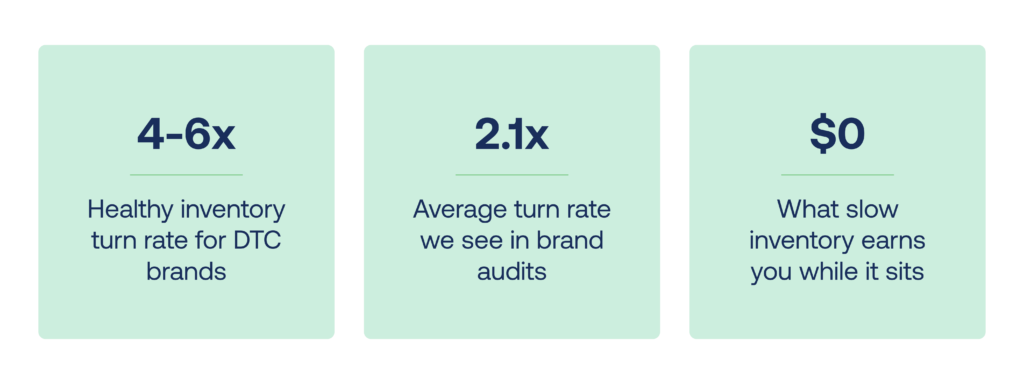
The math is simple, but the implications are massive. If you can move your inventory turnover from 2x to 4x, you’re essentially doubling the speed at which cash cycles through your business. Same revenue, same margins, but dramatically better cash flow. That’s not a supply chain problem fixed. That’s a business transformed.Here’s exactly how we executed it over 8 weeks:
The 8-Month Story: Why “Deep Stock” Isn’t Smart
One of the most common things I hear from founders: “I’d rather have too much than run out.”
I get it. Stockouts hurt. They kill your ad spend efficiency, frustrate customers, and tank your Best Seller ranking on Amazon. The fear is real. But here’s what overbuying actually does to your business.
Let’s say you’re a skincare brand and you order 8 months of your hero serum because your supplier gives you a better price on the larger order. Feels like a smart move, right? Let’s run the real numbers.
Your landed cost for 8 months of stock: $60,000. Monthly storage at your 3PL: roughly $1,200. Over those 8 months, you’ll pay $9,600 in warehousing alone. Now add the opportunity cost. That $60K, if you’d only ordered 3 months of stock ($22,500), would have freed up $37,500 in working capital. You could have used that on a new product launch, better marketing spend, or just having a cash buffer for the unexpected.
And here’s the part nobody talks about: what if the market shifts during those 8 months? What if a competitor launches something better? What if your packaging needs an update? You’re stuck. You can’t pivot because your cash is locked in product you have to sell through first.
The rule of thumb: For most DTC brands, 6 to 10 weeks of stock (based on your demand forecast, not your gut) is the sweet spot. Anything beyond that should require a strong financial justification, not just a supplier discount.

The 3 Inventory Traps That Drain Your Cash
After working with hundreds of DTC brands, I see the same three patterns over and over. Nearly every cash flow problem traces back to one of these.
Trap 1: “Just in Case” Ordering
This is fear-based purchasing. You order 30% more than you need “just in case.” But that 30% buffer compounds across every SKU, every reorder cycle, every season. If you carry 15 products and you’re over-ordering each one by 30%, you could be sitting on $50K+ in unnecessary inventory at any given time. Safety stock is smart. Anxiety stock is expensive. The difference is data.
Trap 2: The MOQ Trap
Your supplier says the minimum order quantity is 5,000 units. You only need 2,000. But the per-unit cost at 5,000 is 18% cheaper. So you order 5,000, congratulate yourself on the unit savings, and then watch 3,000 units sit in a warehouse for 9 months. The “savings” on unit cost get eaten alive by storage fees, tied-up cash, and obsolescence risk. Sometimes the more expensive per-unit option is the cheaper business decision. Always run the total cost of ownership, not just the unit price.
Trap 3: SKU Sprawl
Every new color, size, scent, or variation adds complexity. More SKUs mean more purchase orders, more warehouse slots, more forecasting variables, and more cash spread thin across products that may never earn their keep. If you haven’t done a SKU rationalization in the last 6 months, you’re almost certainly carrying dead weight. The 80/20 rule applies here relentlessly: 20% of your SKUs are likely driving 80% of your profit.
Why Inventory Is the Real Cash Killer
Here’s what makes inventory different from every other expense in your business: it’s invisible until it’s a crisis.
You feel the pain of a high ad spend every month when the credit card bill arrives. You see payroll hitting your account every two weeks. But inventory? It sits quietly on your balance sheet, looking like wealth, while it slowly suffocates your ability to operate.
I’ve seen brands with beautiful gross margins, strong repeat purchase rates, and growing revenue that still can’t make rent because their cash is trapped in inventory they ordered six months ago. The P&L says they’re winning. The bank account says otherwise.
This is why the MOVE DTC Flywheel™ exists. When your marketing, operations, and finance teams are aligned, your purchasing decisions are informed by sell-through data, your marketing spend matches what’s actually in stock, and your finance team isn’t surprised by a $80K purchase order they didn’t see coming. That alignment is what turns inventory from a cash trap into a cash engine.
The Weekend Audit: 4 Questions to Start
You don’t need a consultant or an expensive software tool to start fixing this. You need 30 minutes and honest answers to four questions.
- What’s your current inventory turnover rate? Pull your COGS for the last 12 months. Divide it by your average inventory value. If the number is below 4, you have a cash problem hiding in your warehouse. Below 3? It’s urgent.
- How many months of stock are you holding right now? Take your current inventory value and divide it by your average monthly COGS. If the answer is more than 3 months for any single SKU, ask yourself why. Is there a data-driven reason, or did you just order too much last time?
- Which SKUs haven’t moved in 90+ days? These are your cash hostages. Every day they sit in your warehouse, they’re costing you storage fees and opportunity cost. Build a liquidation plan: bundle them, discount them, donate them. Get that cash moving again.
- Are you ordering based on data or instinct? If you can’t point to a demand forecast that informed your last purchase order, you’re guessing. And guessing with $20K, $50K, or $100K at a time is not a strategy. It’s a gamble.
Your action item: This weekend, run these four numbers. Write them down. Look at them honestly. If anything surprises you, that’s where the opportunity is. Most founders who do this exercise for the first time find $20K to $50K in trapped cash they can start freeing up immediately.
What’s Coming This Month: Freeing Your Trapped Cash
This post is the starting point. Over the rest of the month, we’re going deeper into the practical systems that turn inventory from a cash drain into a competitive advantage.
We’ll cover how to build a demand forecasting rhythm that’s simple enough to maintain weekly, how to negotiate smarter MOQs with your suppliers (yes, they’re usually more flexible than they tell you), and how to set up reorder triggers that keep you stocked without over-committing cash.
If this post hit close to home, the next few weeks are going to change how you think about your entire operation. Because once you stop treating inventory as a stockpile and start treating it as a cash flow tool, everything else in your business gets easier: hiring, marketing, product development, and the mental weight of wondering why growth doesn’t feel like winning.
Your cash isn’t gone. It’s just stuck. Let’s go get it back.
Until next time,
— Lara
Want to Go Deeper?
Watch the full inventory cash flow breakdown on YouTube, where Lara walks through a live audit of a real DTC brand’s inventory, shows exactly where the cash was trapped, and demonstrates how to calculate your own numbers step by step.
Already know your bottleneck?
Join the Supply Chain Lounge on Slack where we discuss these exact challenges every week.