
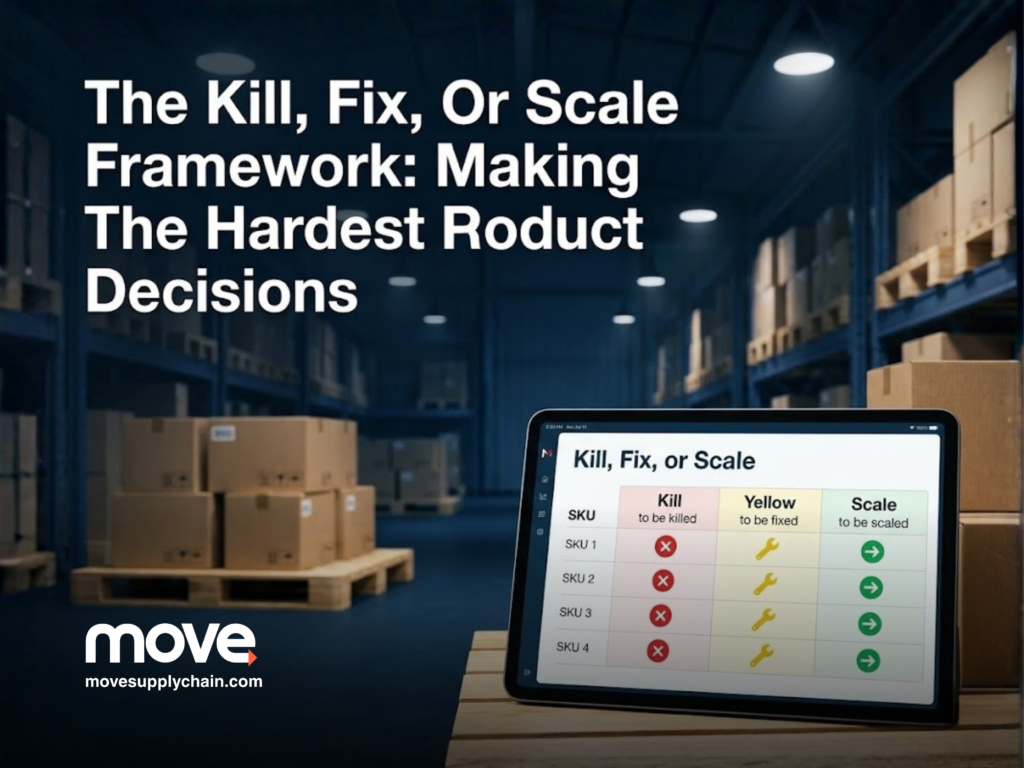
Once you see your true unit economics, every product falls into one of three buckets. Here’s the framework for deciding what to kill, what to fix, and what to scale, and the courage to actually do it.
“But It’s Our Best Seller.”
I hear this sentence every week. Usually followed by tears, frustration, or that specific kind of silence that means someone’s world just shifted.
Because “best seller” means highest revenue. It doesn’t mean highest profit. And the gap between those two things is where DTC brands go to die.
Last month, I worked with a founder whose best seller drove 40% of revenue. She was proud of it. It was the product she talked about in every interview. It got 60% of her ad spend. It was “the product that built the company.”
Contribution margin? 11%.
Meanwhile, three “boring” products nobody talked about were sitting at 28–35% contribution margin. She’d been starving her winners to feed her losers for two years.
This is more common than you think. And it’s exactly why I built the Kill, Fix, or Scale framework.
The Framework
Once you see your unit economics clearly, including all the costs most founders forget, every product falls into one of three buckets.
Kill: Contribution margin under 5% with no realistic path to improvement. The product is a zombie. It’s consuming resources like inventory capital, warehouse space, and management attention, and giving nothing back.
Fix: Contribution margin 5–15% with clear levers to pull. There’s potential here, but only if you act. Set a 90-day deadline with specific targets. If it doesn’t move to Scale by then, it becomes Kill.
Scale: Contribution margin above 20%. These are your winners. They deserve more inventory depth, more marketing budget alignment, and more organizational attention. Stop treating them like afterthoughts.
The 5 Fix Levers
When a product lands in the Fix bucket, you don’t just hope it gets better. You pull specific levers, measure the impact, and make a call within 90 days.
Lever 1: Renegotiate COGS. Most DTC founders accept their supplier’s first price and never revisit it. If you’ve scaled volume since your last negotiation, you have leverage. Use it. Even a 5–8% reduction in COGS can move a product from Fix to Scale.
Lever 2: Fix your freight. Are you shipping this product the most cost-effective way? A lot of founders default to the same shipping method for every SKU without doing the math. Sometimes switching from air to sea on even part of your supply chain changes everything.
Lever 3: Raise the price. I know. Scary. But if your product has strong reviews and low return rates, you probably have more pricing power than you think. Test a 10–15% price increase on a segment of your traffic. You’ll lose some volume, but if contribution margin jumps 5+ points, you’ve found your answer.
Lever 4: Kill the discounts. Discounting is the fastest way to destroy contribution margin. I’ve seen brands run a “limited time” 20% off sale that quietly became permanent. Every dollar you discount comes straight out of margin.
Lever 5: Reduce returns. A 15% return rate doesn’t just mean 15% less revenue. It means wasted shipping, repackaging costs, and often unsellable inventory. Improving product descriptions, sizing guides, and packaging can cut returns by 30–50%. That’s pure margin recovery.
Pull one lever at a time so you can measure what’s working. Stack them over 90 days. If the product still isn’t moving toward 20%+ contribution margin, you have your answer.

How to Actually Kill a Product
This is the part nobody teaches you.
Killing a product isn’t just deleting a listing. It’s a process, and doing it wrong can cost you more than keeping the zombie alive.
Step 1: Sell through existing inventory. Don’t panic-discount to zero. Create a clearance strategy that recovers as much margin as possible. Bundle the dying SKU with a Scale product. Offer it as a gift-with-purchase above a certain cart value.
Step 2: Communicate with your customers. If it’s a product people reorder, give them notice. “We’re retiring this product on [date]. Stock up now.” You’d be surprised how much urgency this creates, and it’s honest.
Step 3: Redirect the resources. This is the part that actually matters. Every dollar of inventory capital, every hour of management attention, every square foot of warehouse space that was feeding the zombie? Redirect it to your Scale products. This is where the real ROI of killing a product lives.
Step 4: Update your demand forecasting. Remove the dead SKU from your projections and recalibrate. A cleaner forecast means better purchasing decisions going forward.
The Sunk Cost Trap
Let’s talk about the real reason founders don’t kill products: ego.
“We spent $80K developing this.” “We just ordered 10,000 units.” “This was my idea.”
I get it. I’ve been there in my 17 years of doing this. But here’s the truth: the $80K is gone whether you keep selling the product or not. The 10,000 units are a liquidation problem, not a reason to keep investing.
Sunk costs are not a strategy. They’re an anchor. And the longer you hold on, the heavier they get.
The best founders I work with have learned to separate the decision they made yesterday from the decision they need to make today. Yesterday’s decision got you here. Today’s decision gets you to profitability.
What Scale Really Means
Most founders hear “scale” and think “spend more on ads.” That’s part of it, but it’s not even the most important part.
Scaling a product means building the supply chain infrastructure to support growth without margin erosion. It means negotiating volume pricing with your suppliers before you need it. It means securing enough inventory to avoid stockouts during peak demand without overbuying and sitting on dead stock.
Real scaling is a coordination act between marketing, supply chain, and finance. I call this the MOVE DTC Flywheel™. When these three functions are aligned, scaling a winning product creates a compounding effect. When they’re not, scaling just amplifies your existing problems faster.
The Emotional Reality
I’m not going to pretend this is easy. Killing a product you created feels personal. Admitting that your best seller is actually your worst performer requires real courage.
But here’s what I’ve seen happen every single time a founder runs this framework honestly:
They feel lighter. They make faster decisions. Their cash flow improves within 60 days. Their team stops spinning on low-impact work.
And the products they thought were “boring”? They become the new stars. Because winners treated like winners tend to win bigger.
You don’t need more products. You need the right products, with the right margins, getting the right attention.
That’s the Kill, Fix, or Scale framework. It’s simple. It’s uncomfortable. And it works.
Until next time,
– Lara
Want to Go Deeper?
I walk through this framework with real examples. Watch the Kill, Fix, or Scale breakdown on YouTube to see how I’d apply each lever to actual products, complete with the math.
Already know your bottleneck?
Join the Supply Chain Lounge on Slack where we discuss these exact challenges every week.