
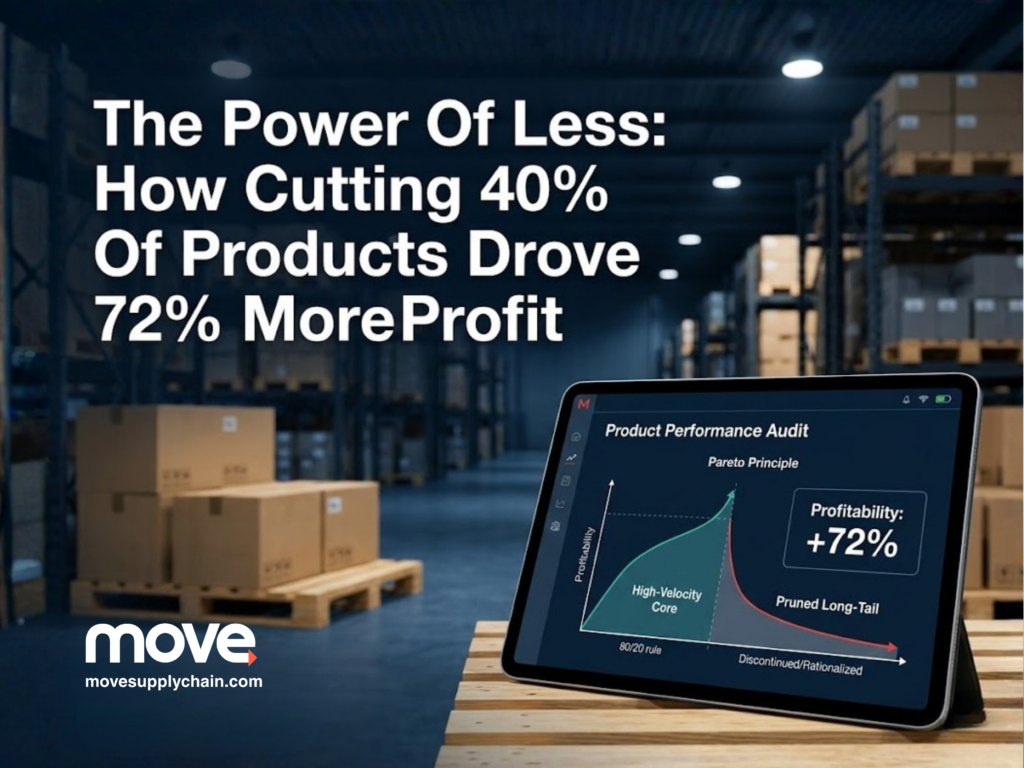
A complete case study in SKU rationalization, from discovery to execution to outcome.
$2M in revenue. 23 products. 4 years in business. And the founder hadn’t paid herself a real salary in 3 years.
“We’re doing fine,” she told me on our first call.
She wasn’t fine. She was drowning in slow motion.
Revenue was growing. Orders were coming in. From the outside, the brand looked like a success story. But behind the Shopify dashboard, the reality was brutal: cash was constantly tight, inventory was piling up in the wrong places, and every new product launch felt like a financial gamble that never quite paid off.
This is the story of how we helped her cut 40% of her product catalog and increase profit by 72% in six months. Not by working harder. By working with better data.
If you’ve ever wondered whether your product line is helping or hurting you, this one’s for you.
The Setup
Let’s call her Megan. She started her brand in 2021 with three core products: a hero SKU that customers loved, a complementary item, and a seasonal variation. Clean. Simple. Profitable.
Then growth happened.
By the time she came to us, those three products had expanded to 23. Some were line extensions (“customers kept asking for new colors”). Some were seasonal launches that never got sunset. Some were ideas that tested well on Instagram but never translated to repeat purchases.
Sound familiar? If you’re running a DTC brand, it probably does. I’ve seen this pattern play out hundreds of times across my 17 years in supply chain. Founders grow their catalog because it feels like progress. More SKUs, more revenue, more options for the customer. But more SKUs also means more complexity. More inventory. More cash is locked up. More room for things to go sideways.
And that’s exactly what happened to Megan.
The Discovery
When we ran Megan’s numbers, the picture was clear and painful.
Of her 23 products, only 6 were actually profitable after you factored in the real costs: not just COGS, but landed costs, warehousing fees, marketing spend per SKU, and return rates. The remaining 17 products ranged from breaking even to actively losing money on every sale.
This is what I call the “gross margin lie.” Founders look at their overall gross margin and think they’re healthy. But when you drill into the contribution margin at the SKU level, factoring in variable costs like shipping, ad spend, storage, and fulfillment, the picture often flips entirely.
The 80/20 rule in action: Megan’s top 5 products generated 83% of her profit. The bottom 12 products were collectively costing her $4,200/month in warehousing, fulfillment complexity, and ad spend that never converted.
Here’s what we found when we dug deeper:
7 products had an inventory turnover rate below 2x per year, which meant they were sitting in the warehouse eating up cash and shelf space. 4 products had return rates above 15%, creating a hidden cost that never showed up in her standard P&L. 6 products were cannibalizing sales from her hero SKU because they were too similar in positioning but had worse margins.
Megan wasn’t running a $2M brand. She was running a $2M revenue engine that was burning cash to maintain products nobody was buying.
The Decision
Here’s where most founders freeze.
Cutting products feels like going backward. You spent money developing them. Customers bought them (even if only a few). Your team designed the packaging, shot the photos, wrote the copy. There’s an emotional attachment that’s hard to separate from the financial reality.
I told Megan what I tell every founder in this situation: you’re not killing products. You’re freeing up the resources to double down on what’s actually working.
We used a simple framework to make the decision. We scored every SKU across four dimensions: contribution margin (the real one, not gross margin), inventory turnover velocity, customer acquisition cost per SKU, and strategic value to the brand. Strategic value was the only subjective measure, and it accounted for things like brand positioning, customer loyalty drivers, and future product line potential.
When we ranked all 23 products, the cut line was obvious. 9 products needed to go immediately. Another 5 were on a “sunset” track, meaning we’d sell through existing inventory but not reorder. That left 9 core products, which we’d refocus the entire business around.
Megan didn’t love it. But she trusted the data.
The Execution
This is the part most people skip when they talk about SKU rationalization. They make it sound like you flip a switch. You don’t. You need a plan, a timeline, and a system to manage the transition without torching your customer relationships or your cash flow.
Here’s exactly how we executed it over 8 weeks:
- Weeks 1–2: Liquidation Strategy. We launched targeted clearance campaigns for the 9 products being cut immediately. No desperate “everything must go” energy. Instead, we used bundled offers (pair a slow mover with a hero product at a slight discount), email-only flash sales to the existing customer base, and strategic placement as add-on items at checkout. Goal: recover as much cash as possible from existing inventory.
- Weeks 2–3: Supplier Communication. We notified all suppliers about the changes. For the 5 sunset SKUs, we negotiated final, smaller production runs to fulfill existing backorders without committing to new inventory. For the 9 core products, we began renegotiating terms. With fewer SKUs, Megan had more leverage to consolidate orders and push for better pricing.
- Weeks 3–4: Warehouse Restructure. With fewer products, Megan’s 3PL was able to reorganize pick-and-pack workflows. Fulfillment errors dropped. Pick times decreased. And because she was now storing fewer items, her monthly warehousing costs dropped by 22% almost immediately.
- Weeks 4–6: Marketing Refocus. This was the big unlock. Instead of splitting ad spend across 23 products, Megan’s marketing team now concentrates budget on 9 proven winners. Cost per acquisition dropped. Return on ad spend climbed. Her creative team produced better assets because they weren’t stretched across two dozen product lines.
- Weeks 6–8: Demand Forecasting Reset. With a leaner catalog, demand forecasting became dramatically simpler and more accurate. Fewer SKUs meant cleaner data, tighter reorder points, and less guesswork. We rebuilt Megan’s inventory plan around her top performers with proper safety stock calculations and lead time buffers.
The Panic (Month 1)
I’d be lying if I said the first month was smooth.
Revenue dipped 18% in week three. Megan called me at 9 PM on a Tuesday. “We’re losing customers,” she said.
We weren’t losing customers. We were losing low-value transactions. The people buying her discontinued products were mostly one-time purchasers with high acquisition costs and low lifetime value. They weren’t her core audience.
But watching revenue drop, even temporarily, even when you know why, is terrifying. That’s the part no case study ever talks about. The emotional toll of doing the right thing when the short-term numbers look wrong.
I told Megan to look at two numbers instead of top-line revenue: her average order value (which was climbing because customers were now buying her better products) and her contribution margin per order (which had already started increasing). The signals were there. She just had to trust the process.
The Outcome (6 Months Later)
Knowing when to order is half the battle. The other half is knowing how much.
72%
Increase in net profit over 6 months
Six months after we started the SKU rationalization, here’s where Megan’s brand stood:
Net profit increased 72%. Not revenue. Profit. The money she actually kept. Revenue only grew 11%, but because she eliminated the drag of unprofitable products, every dollar of revenue was worth significantly more.
Warehousing costs dropped 28%. Fewer products meant less space, fewer handling fees, and fewer fulfillment errors. Her 3PL even offered her better rates because her operations were now simpler and more predictable.
Marketing efficiency improved by 34%. With a focused catalog, her marketing team produced higher-converting campaigns. Customer acquisition cost dropped because they were targeting the right audience with the right products instead of spreading spend thin.
Inventory turnover jumped from 3.1x to 5.8x annually. Cash that used to sit in slow-moving inventory was now cycling through the business faster, giving Megan the working capital she needed to invest in growth on her own terms.
And the number that mattered most to Megan? She finally paid herself a real salary. For the first time in three years.ow to vet backup suppliers so you are never locked into one vendor’s terms.

The Lesson
SKU rationalization isn’t about shrinking your business. It’s about right-sizing it.
Most DTC founders I work with have been taught that growth means more: more products, more launches, more variations, more everything. And for a while, it works. Revenue goes up, and the problems hide behind top-line numbers.
But eventually, the complexity catches up. Your cash is trapped in inventory that doesn’t move. Your team is overwhelmed managing products that don’t perform. Your marketing budget is diluted across too many SKUs to be effective on any of them.
The brands that scale sustainably are the ones that get ruthless about what stays and what goes. They don’t launch new products because customers asked once. They launch because the data supports it, the supply chain can support it, and the margins justify it.
This is the core of what we call the MOVE DTC Flywheel™: getting your marketing, operations, and finance aligned so they’re all pointing in the same direction. When those three functions talk to each other, decisions like SKU rationalization stop being scary and start being obvious.
Your action item this week: Pull your SKU-level contribution margin report. Not gross margin. Contribution margin. Factor in COGS, landed costs, warehousing, fulfillment, returns, and ad spend per product. Rank your products from highest to lowest. I guarantee the bottom 20% will surprise you.
What Comes Next: Building the Catalog That Scales
Cutting products is only half the equation. The other half is building the operational infrastructure that prevents the same problem from happening again.
That means implementing a stage-gate process for new product development, so every new SKU has to prove its financial case before it earns shelf space. It means building vendor relationships that give you flexibility without locking up cash. And it means creating a rhythm of quarterly SKU reviews so your catalog stays lean as you grow.
Next month, we’re going deeper into the demand forecasting side: how to predict which products to scale, when to reorder, and how to avoid the cash flow traps that kill growing brands. If Megan’s story resonated with you, that’s the next piece of the puzzle.
Because the goal isn’t to have fewer products. The goal is to have the right products, at the right time, in the right quantities, with the right margins. That’s what supply chain excellence looks like for DTC brands. And it starts with knowing your numbers.
Until next time,
— Lara
Want to Go Deeper?
Watch the full SKU rationalization breakdown on our YouTube channel, where Lara walks through the exact framework that made this transformation possible.
Already know your bottleneck?
Join the Supply Chain Lounge on Slack where we discuss these exact challenges every week.