
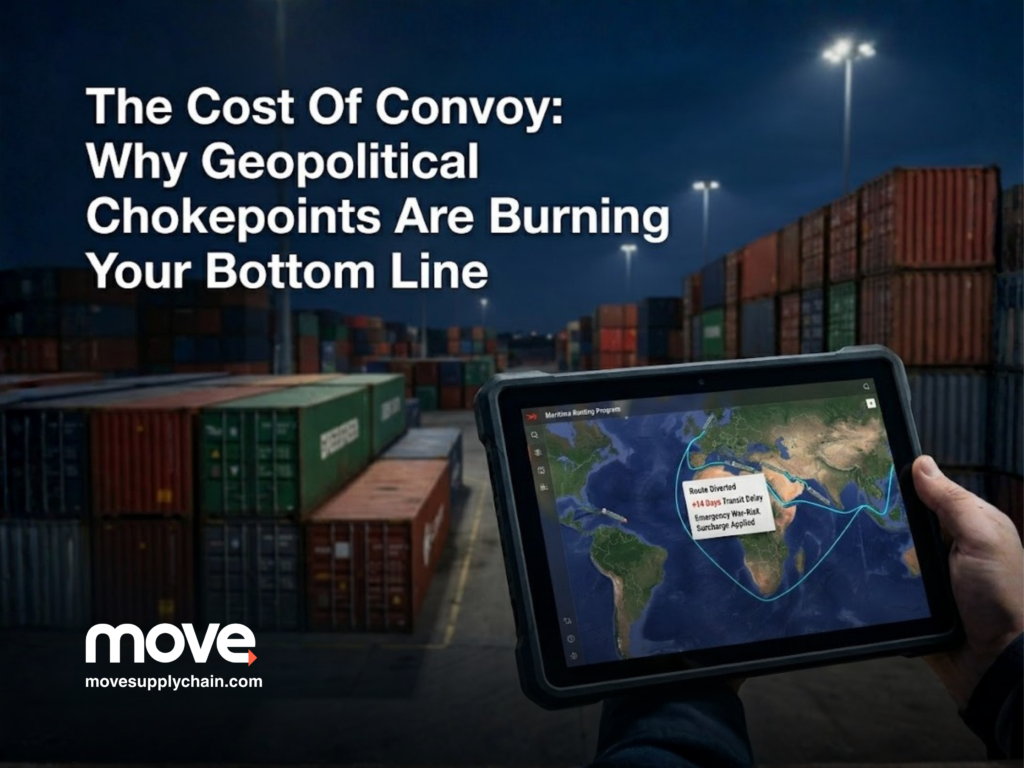
Everyone is talking about getting out of China. The Strait of Hormuz just closed. Tariffs are at 125%+. Here’s what actually happens when you act on that urgency, and the framework you need before you move anything.
Everyone is talking about getting out of China. Right now, it’s louder than ever.
The Strait of Hormuz just closed – 20% of global oil, 18% of global air freight, and major container lines are halting Red Sea routes again. China tariffs are sitting at 125%+ for many categories. Founder group chats are on fire. The pressure to diversify has never felt more urgent.
And this is exactly when founders make the most expensive mistakes.
In 17 years in supply chain – from Fortune 500 procurement to working directly with DTC brands – I’ve watched this pattern repeat every time a headline crisis hits. The urgency is real. The events are real. And the sourcing decisions made in this moment are the ones that cost $34K, $47K, sometimes more.
This week, we confront the China+1 fantasy with reality. Not because diversification is wrong – it can and does work. But because panic-driven diversification is wrong. And the environment we’re in right now is the most emotionally charged sourcing moment in recent memory.
What the Current Environment Actually Means
Before we get into the framework, there’s a nuance that almost nobody is discussing in the group chats right now:
Moving production to Vietnam, India, or Bangladesh doesn’t automatically move your shipping risk.
The Strait of Hormuz and Red Sea disruptions affect goods moving from Southeast Asia just as much as from China. Many Vietnamese, Indian, and Bangladeshi suppliers ship through the same disrupted corridors. If your new alternative supplier uses the same routing, you haven’t diversified your shipping exposure. You’ve added transition cost without reducing the risk you were trying to escape.
Geographic diversification only reduces shipping risk if the alternative actually uses different infrastructure. That requires a routing analysis – not just a factory location comparison.
Meanwhile, the tariff environment at 125%+ has created a genuinely legitimate reason for some brands to do the math. But doing the math is the operative phrase. Global trade projections now expect contraction as manufacturers and investors prioritize risk mitigation. The right response to that environment is analysis – not reflexive action.
The Expectation vs. Reality Gap
What founders expect from diversification: lower tariffs, reduced China risk, similar or lower costs, same quality from day one, faster lead times, and less shipping exposure.
What founders often get: unit costs 15-40% higher in Year 1 even with better tariff rates, quality inconsistency during the learning curve, longer lead times while the new relationship develops, communication gaps, lost expertise on complex products – and sometimes, the same shipping lane exposure they thought they were escaping.
The gap exists because China’s manufacturing ecosystem took decades to build. New regions don’t inherit it. And new suppliers start at zero on your specs, your standards, your communication style. That learning curve has a real cost.
Three Right Reasons to Diversify
1. Tariff Arbitrage
At 125%+ on many China categories, the duty savings calculation has become genuinely compelling for some brands. But compelling means worth running the full model – not worth assuming the move pays off. The real calculation: tariff difference minus unit cost increase minus transition costs minus quality learning curve cost, over 24 months. If it closes positively, it’s a right reason.
2. Geographic Risk Mitigation
When concentration in one region is existential – and the alternative uses genuinely different infrastructure. This is the critical update for the current moment. COVID taught us about single-region concentration risk. The Strait of Hormuz closure is teaching us about single-route shipping risk. Geographic diversification only reduces risk if the alternative country’s routing is actually different. Map it before you move.
3. Lead Time Optimization
When proximity to market meaningfully changes your ability to serve customers – modeled against current routing realities, not just destination lead times. With Red Sea and Hormuz disruptions active, routing is now part of the lead time model. A Mexico supplier’s 3-week lead time assumes open Pacific routes. A Vietnam supplier’s lead time assumes routes that may currently be disrupted. Model both.
Three Wrong Reasons (Why They’re Worse Right Now)
1. Fear
The Strait of Hormuz just closed. Tariffs are at 125%+. Your group chat is on fire. These are real events – and they are not a sourcing strategy. The founders in our case studies made their moves in far calmer environments than this one. The emotional charge of the current moment makes the fear-driven mistake more likely and more expensive.
2. Peer Pressure
Your competitor moving to Vietnam doesn’t mean your product, volume, supplier relationships, or routing situation can support the same move. What worked for their product category and their logistics setup may be completely wrong for yours. Their routing analysis is not your routing analysis.
3. Assumption
Assuming the alternative is cheaper, faster, or safer without doing the landed cost math, the quality audit, and the logistics routing analysis. All three. Right now, assumptions are especially dangerous because the environment feels so urgent – and urgency makes it easy to convince yourself that the analysis can wait.
The True Cost Calculation
Most founders are looking at the tariff savings line and stopping there. At 125%+, that line looks compelling. But it’s one of six components that Finance needs to model.
The complete landed cost model for any sourcing decision right now:
- Current tariff rate vs. alternative country tariff rate – yes, at 125%+ this line now swings significantly for many categories
- Unit cost differential – typically 15-40% higher in Year 1 for a new supplier relationship
- Transition and tooling costs – samples, facility visits, QC setup, spec development, tooling transfer
- Quality learning curve buffer – budget 3-5x your current defect rate for Year 1, and account for the cashflow impact of higher returns
- Freight differential – route length, current surcharges, carrier availability on specific corridors
- Shipping route risk analysis for both origin countries – non-negotiable in the current environment
That sixth component is new and essential. The Strait of Hormuz disruption proves that geographic diversification only reduces shipping risk if the alternative actually uses different infrastructure. If your Vietnam supplier ships through the Red Sea corridor – same as your China supplier – you have not reduced that exposure. You’ve added transition cost on top of the same risk.
Finance needs to run all six components before any sourcing decision is made. The spreadsheet matters more than the strategy deck, and right now it matters more than the headlines.
The Founders Who Got Burned
These three cases happened in calmer sourcing environments than the one we’re in today. That makes them more relevant, not less.
Case 1: The Vietnam Move
A brand moved production to Vietnam for tariff savings when China tariffs were far lower than today’s 125%+. Unit cost went up 22%. Defect rate tripled from 2% to 6%. They dual-sourced for 18 months while Vietnam climbed the quality curve. Net cost: $34K more than if they’d stayed. The routing analysis they never ran revealed their Vietnam supplier used the same Red Sea lanes as their China supplier. Different country. Same shipping exposure. New costs on top.
Case 2: The Mexico Dream
A brand moved to Mexico for faster US delivery. The supplier took the order but couldn’t fill it – capacity was constrained. Lead times went up, not down. They paid $28K in emergency air freight to cover stockouts. The speed case was legitimate. The capacity modeling was missing. A right reason executed without the full analysis still burns you.
Case 3: The India Experiment
A brand moved a complex product to India for cost savings. No facility visit. Communication gaps caused wrong specs on three consecutive production runs. $47K in unsellable inventory. Back to their original China supplier within 8 months. The communication infrastructure was never assessed. The routing was never mapped.
The pattern across all three: founders responding to real pressure – tariffs, headlines, competitive moves – and letting that pressure replace the process. The pressure they felt was lower than what founders are feeling right now. The lesson is proportionally more important.
What the Model Needs Now
The MOVE DTC Flywheel connects Marketing, Operations (Supply Chain), and Finance. Diversification decisions sit squarely in Operations – but they land directly on the Finance P&L, and Finance needs to be running the model before any sourcing move is made.
The updated Finance model for any sourcing decision in the current environment must include all six components above. Specifically:
- Tariff savings are real at 125%+ – but they only materialize if the landed cost model closes across all other components
- Quality learning curve cost should be modeled as a cashflow item, not just a per-unit cost – because higher defect rates in Year 1 affect working capital and customer experience simultaneously
- Shipping route risk is now a financial risk, not just a logistics risk – if the alternative route is disrupted, your lead time model breaks and your stockout exposure increases
- Transition period requires a financial cushion – the 18-24 month runway during which costs are higher before they normalize
This is about making sure the sourcing decision that feels urgent right now doesn’t create the hidden costs of next quarter.
Until next time,
— Lara
The Headlines Are Loud. The Framework Has to Be Louder.
The Strait of Hormuz closure, 125%+ tariffs, and Red Sea disruptions aren’t just logistics news — they’re reshaping global trade routes in real time. I break down how geopolitical shifts and maritime security actually flow through to your supply chain costs, your lead times, and your sourcing decisions — before the disruption hits your P&L.
Already know your bottleneck?
Join the Supply Chain Lounge on Slack where we discuss these exact challenges every week.