

Not every product should come from the same place. Use this 4-factor SKU sourcing scorecard to decide what to move, what to keep, and what to dual-source.
When founders think about sourcing diversification, they usually ask the wrong question.
They ask: Should we move production out of China?
The better question: Which products should move, and which should stay?
Sourcing is not a brand-level decision. It is a SKU-level decision. The same brand might have products that should stay in China, products that should move to Vietnam, and products that should be split across both. Treating every SKU the same is how brands end up with expensive transitions that hurt quality, or unnecessary concentration risk they could have addressed years ago.
This post gives you the framework to sort your catalog and make the decision SKU by SKU.
Why SKU-Level Thinking Changes Everything
Most sourcing conversations start at the brand level. Leadership decides the company is too concentrated in one region. The directive goes out: diversify. Supply chain scrambles to find alternative suppliers. Products get moved. Problems follow.
The products that move fastest are usually the ones someone had an existing contact for, or the ones that felt easiest. Not the ones that were actually the right candidates.
The result: the wrong SKUs move. The complex, margin-sensitive, quality-dependent products that should have stayed with a proven supplier get transitioned to a new one still building capability. The simple, high-volume, high-margin products that would have moved smoothly stay put.
Sorting your catalog before you make any decisions prevents this. It takes the guesswork out and replaces it with a repeatable framework.
What Is SKU-Level Sourcing Analysis?
SKU-level sourcing analysis is the process of evaluating each product in your catalog against a defined set of criteria to determine the optimal manufacturing strategy for that specific item. Rather than applying one sourcing decision across all products, brands score each SKU individually and route it to the strategy that fits: stay with the current supplier, move to a new region, or split production across two sources.
For DTC brands managing 10 to 100-plus SKUs, this analysis typically reveals that no single sourcing strategy is right for every product. The catalog naturally segments into distinct groups, each with a different ideal approach.
The 4 Factors That Determine Sourcing Fit
Every SKU gets evaluated on four factors. Each one tells you something different about where that product belongs.
Factor 1: Complexity
Complexity is about how many things can go wrong in production.
Low-complexity products have simple construction, standard materials, and tolerances that a new supplier can hit quickly. They transfer well. A new supplier can get up to speed in months, not years.
High-complexity products have intricate assembly, tight tolerances, specialized materials, or multi-step processes where quality depends on accumulated knowledge. That knowledge lives in your current supplier. Moving it is not impossible, but the learning curve is real and it has a cost.
The question to ask: How many things can go wrong in production, and how long did it take your current supplier to stop getting them wrong?
Factor 2: Margin
Margin is about what the product can afford.
High-margin products can absorb transition costs: the higher prices while a new supplier is learning, the quality issues that surface in the first few production runs, the additional inspection and testing required before you trust the output. These costs are real, but they are recoverable.
Low-margin products cannot afford them. A 15% cost increase during a transition, plus one bad production run, can turn a low-margin product into a money-losing one faster than you expect.
The question to ask: If costs increase 15% during transition and you absorb one quality issue in the first six months, does the product still make money?
Factor 3: Volume
Volume determines whether a new supplier will take you seriously.
High-volume SKUs justify the investment of building a new supplier relationship: the sample rounds, the audits, the time spent on quality alignment, the first production run hand-holding. A supplier receiving significant annual orders will prioritize your account and invest in getting it right.
Low-volume SKUs may not clear that threshold. A supplier taking on a new brand for 500 units per year is not going to dedicate the same attention as one receiving 10,000. You may be a low-priority account from day one, which is a difficult position when you are also asking them to learn your product.
The question to ask: Is the annual volume on this SKU enough for a new supplier to genuinely prioritize your business?
Factor 4: Lead Time Sensitivity
Lead time sensitivity is about whether speed of production creates competitive advantage for this specific product.
Some products are highly lead-time sensitive: trend-driven items, seasonal launches, products where out-of-stock events cost disproportionate revenue. For these, nearshoring to a closer region can change the game. Two to three weeks faster can mean catching a demand window you would otherwise miss.
Other products have more predictable demand and long planning horizons. If you are forecasting 12 months out and running replenishment orders on a steady cycle, the geographic distance of your supplier matters less than their reliability and cost.
The question to ask: Would two to three weeks faster delivery materially improve the business for this product?

The SKU Sourcing Scorecard
Score each SKU from 1 to 5 on each of the four factors above. Higher scores indicate stronger candidates for moving or dual-sourcing.
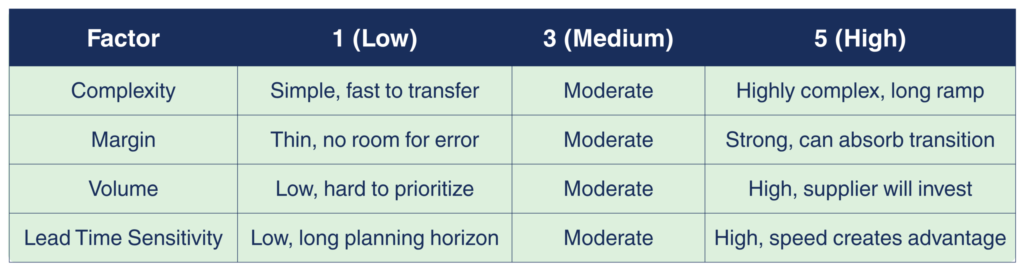
Score interpretation:
- 16 to 20: Strong move candidate. This SKU has the profile to transfer successfully.
- 11 to 15: Dual-source candidate. Split production to build capability while protecting quality.
- 6 to 10: Stay. The risk or economics do not support a move right now.
- 4 to 5: Definitely stay. Moving this SKU is likely to cost more than it saves.
Run every SKU in your catalog through this scorecard before making any sourcing decisions. The results will often surprise you.
The Complexity Factor: A Real Example
Complexity deserves more time because it is the factor brands most consistently underestimate.
I worked with a brand that decided to diversify production on two product lines at the same time: a line of consumer electronics accessories and a line of simple home goods. Both were moving to a new region, away from a Chinese supplier they had worked with for three years.
The home goods line moved in four months. Minor fit-and-finish issues in the first run, corrected quickly. The new supplier was up to full quality within two production cycles.
The electronics accessories line was a different story. The Chinese supplier had accumulated three years of process knowledge: specific assembly sequences, supplier relationships for specialized components, informal quality checks that had evolved through dozens of production runs. None of that was documented. None of it transferred to the new supplier automatically.
Fourteen months in, they had spent $38,000 in defective product, rework, and quality inspection. The new supplier eventually got there. But the timeline and cost were far beyond what anyone had projected.
Same brand. Same diversification decision. Different SKU complexity, completely different outcome.
High-complexity products are not impossible to move. They require more time, more documentation, more overlap with the existing supplier, and a longer quality ramp expectation built into the plan from the start.
The Dual-Sourcing Strategy
For SKUs that score in the 11 to 15 range, dual-sourcing is often the right answer. Not a full move. Not staying put. A deliberate split.
The structure that works for most brands is a 70/30 split: primary supplier handles 70% of production volume, secondary supplier handles 30%. You are not abandoning your proven supplier. You are building capability with a backup while maintaining quality through the majority of your volume.
What this achieves:
It builds real capability. A supplier receiving 30% of a meaningful SKU volume has enough to learn the product properly. They are not doing sample runs. They are running real production.
It creates leverage. A current supplier who knows 30% of volume is going elsewhere has a meaningful reason to maintain competitive pricing and service quality.
It provides backup. When your primary supplier has a capacity issue, a Lunar New Year delay, or a quality problem on a run, you have an operational backup that already knows the product.
The honest warning: Dual-sourcing adds complexity. Two supplier relationships to manage, two quality systems to maintain, two production schedules to coordinate. It is worth it for strategic SKUs. It is not worth it across an entire catalog. Reserve it for products where the risk of single-source concentration is high enough to justify the management overhead.
Case Study: Sorting 28 SKUs for a $4M Brand
A $4M DTC brand came to us with 100% of production concentrated in one region and growing nervousness about what that meant for their business. Twenty-eight SKUs across four product categories.
We ran every SKU through the scorecard.
The results:
- 4 SKUs flagged as strong move candidates: These represented 35% of total revenue. High margin, moderate to high volume, relatively simple construction. Good candidates.
- 6 SKUs flagged for dual-sourcing: 40% of revenue. These were the complex, higher-volume products where a full move carried too much risk but doing nothing felt wrong.
- 18 SKUs scored to stay: 25% of revenue. Low volume, complex construction, thin margin, or some combination. Moving these would have cost more than it saved.
The outcome of implementing those decisions: regional concentration dropped from 100% to 55% over 18 months. No major quality events. No disruption to customer experience.
The critical insight: if they had applied a blanket “move everything” decision, the 18 SKUs that scored to stay would have created significant problems. The scorecard prevented that.
The MOVE Flywheel Connection
This decision does not belong to Supply Chain alone.
Finance needs to model the P&L impact by SKU under different sourcing scenarios before any decision is made. What does a 12% cost increase on a transition SKU do to margin? What does a 3% cost reduction on a successful move do to the bottom line over three years? These numbers drive the decision as much as the scorecard does.
Marketing needs to know if lead times change by product. If a hero SKU moves to a nearshore supplier and lead time drops from 14 weeks to 6 weeks, that changes how Marketing can plan campaigns, manage pre-orders, and respond to demand signals. That is a commercial advantage worth communicating.
Sourcing decisions that happen in a Supply Chain silo without Finance modeling and Marketing input are how brands end up with transitions that make sense on paper and cause problems in practice. Run this as a cross-functional exercise from the start.
Frequently Asked Questions About SKU-Level Sourcing
Should I move all production out of China? Not necessarily, and probably not all at once. The right answer depends on the complexity, margin, volume, and lead time profile of each individual SKU. Many brands find that 30 to 50% of their catalog is best served by staying with established Chinese suppliers, while the remainder has a strong case for diversification.
What is dual-sourcing and when does it make sense? Dual-sourcing means splitting production of a single SKU across two suppliers, typically in different regions. It makes sense for high-revenue SKUs where concentration risk is meaningful but complexity makes a full transition too risky. A 70/30 primary-secondary split is a common starting structure.
How do I know if a product is too complex to move? Ask your current supplier how long it took to achieve consistent quality on that product. If the answer is more than six months, and the quality depends on process knowledge they have accumulated over time, treat it as high complexity. Plan for a longer ramp and more overlap time with the new supplier.
How much volume does a SKU need to justify sourcing diversification? There is no universal threshold, but a useful test is whether annual volume is enough for a new supplier to prioritize your account. If your order represents less than 5% of a supplier’s capacity, you are unlikely to receive the attention a new, learning-curve relationship requires.
How long does it take to move production to a new region? For low-to-moderate complexity products, four to eight months is a realistic timeline from supplier selection to first full-quality production run. High-complexity products can take 12 to 18 months. Build the timeline expectation before you commit to the transition.
What is Coming Next
You have the framework for deciding which SKUs to move. The next question is: how do you find and evaluate the supplier to move them to?
Week 3: How to vet a new supplier without flying there. The audit process, the documentation to request, the red flags that are easy to miss when you are working remotely, and the verification steps that protect you before you commit volume.
See you then,
— Lara
Thinking About Diversifying?
2025 exposed how fragile most single-source setups really are, but the answer isn’t moving everything. It’s knowing which products to move, which to keep, and how to build optionality before the next disruption forces your hand. This episode breaks down exactly that, with a practical playbook for 2026.
Already know your bottleneck?
Join the Supply Chain Lounge on Slack where we discuss these exact challenges every week.