
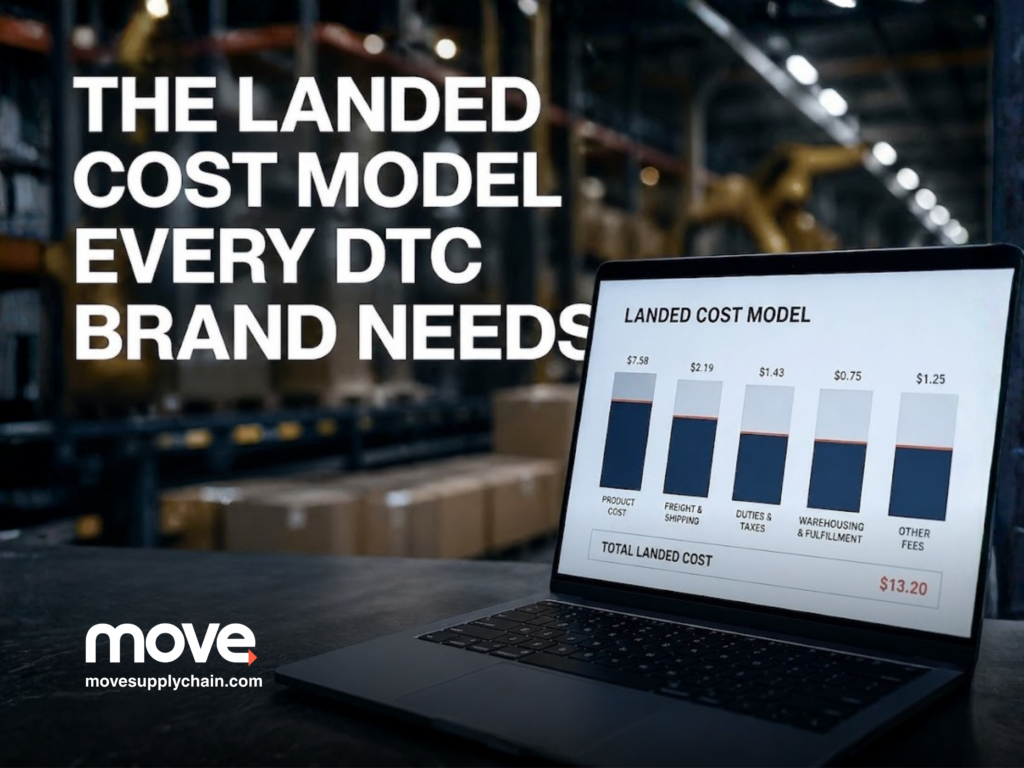
Thinking about moving production out of China? This is the exact landed cost model your Finance team needs before you sign a single new supplier contract.
I’m going to tell you something that a lot of people in the supply chain world won’t say because it’s not exciting enough.
The conversation you’re having about tariffs? You’re having the wrong one.
I’ve talked to dozens of DTC founders over the past few months who are in active conversations with Vietnamese, Indian, and Mexican suppliers right now. And almost every single one of them is making their decision based on one number: the tariff rate differential between China and their alternative country of origin.
That number matters. But it’s one line in a model that should have five.
The founders who get burned on sourcing transitions (and I’ve watched enough of them to know the pattern cold) don’t fail because they were wrong about the tariff rate. They fail because that was the only number they looked at.
Here’s the model they should have run.
Why Tariff Rate Alone Will Lie to You
Let me give you a real scenario. A brand is importing a product from China that’s now sitting under a 125% tariff. They find a Vietnamese supplier who can make the same product. Vietnam’s tariff rate for that category? Significantly lower. On paper, the savings look obvious.
So they place an order.
What actually happened to that brand over the next year:
- The Vietnamese supplier’s unit cost was 28% higher than their Chinese factory — because the Chinese factory had been running their product for four years and had the process dialed in. The Vietnamese factory was still learning.
- Their first two production runs had quality failure rates of 12% and 9%, respectively. Their Chinese factory averaged 1.5%.
- Lead times stretched from 45 days to 72 days while communication rhythms developed. That 27-day gap forced them to carry an additional month of safety stock — capital they didn’t have sitting around.
- Tooling transfer costs, sample rounds, and two factory visits cost them $34,000 before they shipped a single sellable unit.
Did the tariff savings cover it? No. Not even close. Not in year one.
By the time you added it all up, they would have been better off absorbing the tariff and negotiating harder with their Chinese supplier, at least for that first year while the new relationship developed.
This is not a one-off story. This is what happens when founders use tariff math instead of landed cost math.
The 5-Part Landed Cost Model for Sourcing Diversification
Here’s what the full model looks like. Your Finance team needs to build this before any sourcing decision is made, not after you’ve already told a supplier you’re interested.The Four Changes (And the $18K They Found)
Part 1: Tariff Rate Differential (By HTS Code)
Yes, this is part of the model. It’s just not the whole model.
Pull your exact HTS codes for each product you’re evaluating. Don’t estimate the tariff rate can vary significantly within a category depending on how your product is classified. Get the current duty rate for China and the current duty rate for your alternative country of origin for that exact code.
Then calculate the annual duty savings based on your actual import volume. That’s your starting number. Everything else in the model is either adding to or subtracting from it.
Part 2: Unit Cost Differential (From Actual Quotes)
This is where most founders take their first shortcut, and pay for it.
You need real quotes from real suppliers for your real product. Not industry averages. Not a supplier’s catalog pricing. An actual quote based on your specs, your volume, your packaging requirements, and your quality standards.
In my experience, a new supplier in an alternative country will quote you 15–40% higher than your established Chinese factory for the same product, at least in the first year. That gap narrows as the relationship matures and they optimize their process. But you need to model year one costs honestly, not the steady-state costs you hope to achieve in year three.
Take the unit cost differential multiplied by your annual volume. If the alternative supplier is more expensive per unit, subtract that from your tariff savings.
Part 3: Transition and Tooling Costs
These are the costs that almost nobody budgets for until they’re already happening.
Transition costs for a new supplier relationship typically include: tooling transfers or new tooling builds, multiple sample rounds (budget for at least three, you almost never nail it on the first), factory audit costs, any travel required for in-person visits during setup, legal costs for new supplier agreements, and your team’s time managing the transition (which is real cost even when it doesn’t show up on an invoice).
I’ve seen transition costs run anywhere from $8,000 on the low end for simple products to $60,000+ for complex ones. Whatever number you’re thinking, add 30%. Transitions always take longer and cost more than the initial plan.
Add this to your cost column as a one-time hit in year one, then amortize it across your expected relationship length to get a per-unit view.
Part 4: Quality Learning Curve Buffer
This one is uncomfortable to model because it requires admitting that your new supplier will make mistakes. They will. Every new supplier relationship has a learning curve. The question is what it costs you.
Look at your current supplier’s defect or rejection rate. That’s your baseline. Now estimate — conservatively — what your new supplier’s rate will be during the first two to four production runs. Industry data suggests new supplier defect rates run 3–5x higher than established suppliers during the ramp period.
Model what a production run with a 10% defect rate actually costs you: the units themselves, the remediation or disposal cost, the customer service impact if bad product reaches your customer, any expediting costs to fill the gap. That’s your quality buffer number.
If it sounds scary, good. It should be part of the model so you’re making a decision with eyes open not discovering it on the back end of a bad production run.
Part 5: Shipping Route Risk Analysis
This is the step that the current environment makes non-negotiable and the one I see skipped most often.
The Strait of Hormuz disruption is affecting roughly 20% of global oil and 18% of global air freight. Red Sea routes have been disrupted repeatedly. And here’s the thing most founders don’t check: a lot of Southeast Asian manufacturing still uses the same Red Sea corridor to move goods to the US and Europe that Chinese production does.
Before you conclude that moving from China to Vietnam reduces your shipping risk, you need to map the actual routing for both origins. If your Vietnamese supplier’s freight is still transiting the same chokepoints, you haven’t diversified your shipping exposure. You’ve just added unit cost and quality risk on top of the same infrastructure risk you already had.
Map both routes. Understand the exposure for each. If the alternative genuinely uses different infrastructure and different chokepoints, that’s a real risk reduction. If it doesn’t, that has to factor into your decision.

What the Model Tells You (And What to Do With It)
Once you’ve built all five parts, you have a real number: the net financial impact of the sourcing move, year one and projected steady state.
If the model shows you net positive — genuine savings after every cost is accounted for — you have a real business case to move. Start supplier qualification, begin the transition in parallel with your current supplier, and build a realistic timeline that doesn’t leave you inventory-exposed during the switch.
If the model shows you break even or negative in year one, but positive in years two and three as the relationship matures, that’s a strategic decision, not a financial one. You’re investing now for stability later. That might be the right call depending on your tariff exposure and concentration risk. But it needs to be a conscious choice, not an accidental one.
And if the model shows you negative across all years, hold. Negotiate harder with your current supplier. Work the relationship you have. The grass isn’t always greener on the other side of the trade war.
Why This Is a Finance, Operations, AND Marketing Decision
Here’s the piece that trips up even sophisticated brands: the landed cost model only covers the supply chain and finance dimensions. But a sourcing transition also has a Marketing impact that has to be factored in.
If you run short on inventory for two quarters during the transition — because your new supplier’s lead times are longer than expected, or because a quality failure forces you to delay a shipment — your Marketing team is going to feel it. Out-of-stock products mean paused ad campaigns, lost revenue, and customer acquisition costs you can’t recover. That’s real money that belongs in the model, even if it sits in Marketing’s budget and not Operations’.
This is the core of what the MOVE DTC Flywheel™ is built to address. Operations, Finance, and Marketing are not separate decisions. A sourcing move is never just a sourcing move, it is a business-wide decision that touches cash flow, customer experience, and revenue simultaneously. All three functions need to be in the room when the model is built and when the decision is made.
I’ve watched brands make sourcing transitions that looked smart on the supply chain side and created 18-month hangovers on the marketing and finance side. Not because anyone made a bad decision but because only one part of the business was looking at the numbers.
Build the Model First. Make the Decision Second.
The tariff environment right now is genuinely creating real calculations worth running. I’m not dismissing that. For some brands, in some categories, with the right alternative supplier, the move absolutely makes sense.
But the brands that are going to navigate this trade environment well are the ones who build the model before they make the call — not the ones who see a tariff rate difference and start sending RFQs.
Run all five parts. Get actual quotes. Map the shipping routes. Include the quality buffer. Amortize the transition costs. Bring Finance, Operations, and Marketing into the same room.
Then decide.
That’s not a slow process. It’s a smart one. And in this environment, smart is the only strategy that holds.
Frequently Asked Questions: Landed Cost Models for DTC Sourcing
What is a landed cost model in supply chain?
A landed cost model is a complete financial calculation of the total cost to get a product from factory to your warehouse, including unit cost, tariffs and duties, freight, insurance, transition costs, and quality risk buffers. For DTC sourcing decisions, it’s the only accurate way to compare whether switching suppliers or countries will actually save money once all costs are accounted for.
What costs should be included in a landed cost calculation for sourcing diversification?
A landed cost model for sourcing diversification should include five components:
(1) tariff rate differential by HTS code for both origin countries,
(2) unit cost differential from actual supplier quotes,
(3) transition and tooling costs including sample rounds and factory audits,
(4) quality learning curve buffer based on your rejection rate tolerance during ramp-up, and
(5) shipping route risk analysis to confirm the alternative country actually uses different logistics infrastructure.
How do I calculate if moving from China to Vietnam will save money?
To calculate whether moving production from China to Vietnam saves money, compare the full landed cost for both origins, not just the tariff rate. Get real unit cost quotes from Vietnamese suppliers, add one-time transition and tooling costs, include a quality buffer for the ramp period, and map the shipping route for both origins to assess logistics risk. Only if the total model shows net savings should you proceed.
Why do DTC brands lose money when they switch sourcing countries?
Most DTC brands that lose money on sourcing transitions made the decision based on tariff rate comparisons alone. The hidden costs (unit price increases of 15–40% during the learning curve, tooling transfers, quality failures during ramp-up, and longer lead times that inflate safety stock) routinely exceed tariff savings in year one. Without a complete landed cost model, founders consistently underestimate the true cost of switching suppliers.
How does a sourcing transition affect cash flow for a DTC brand?
A sourcing transition affects DTC cash flow in multiple ways: transition and tooling costs require upfront capital, quality failures during ramp-up generate returns and write-offs, longer lead times from a new supplier increase safety stock requirements and tie up working capital, and inventory shortfalls during the switch period reduce revenue and may force ad campaign pauses. A full landed cost model must capture all of these impacts, not just duty savings.
Until next time,
Lara
Running the Sourcing Math?
Don’t Miss What’s Hiding in Your Landed Cost.
Before you move production, your landed cost model needs to be airtight, because the margin you think you’re saving on tariffs can disappear fast in freight, stockouts, and 3PL costs. I break down the top 3 supply chain blind spots that burn DTC founders scaling ads, including real case studies of brands that lost $120K+ getting this wrong.
Already know your bottleneck?
Join the Supply Chain Lounge on Slack where we discuss these exact challenges every week.