
The specific thresholds that tell you it’s time before it’s too late
Most founders switch 3PLs about six months too late. By the time they make the decision, they’ve already absorbed thousands in errors, lost customers from late shipments, and spent hours chasing down missing inventory. The switch feels hard, so they wait. And waiting costs more than switching.
In 17 years of supply chain, I’ve helped dozens of brands through 3PL transitions. Here are the specific, measurable thresholds that tell you it’s time, and how to make the switch without destroying your operations.
The 5 Metrics That Tell You It’s Time
1. Inventory Accuracy Below 99%
Your 3PL should know where every unit is, every time. If their inventory accuracy rate drops below 99%, that 1% discrepancy is quietly costing you. On 10,000 units, 1% is 100 units of mystery inventory, product you can’t sell because you don’t know if you have it.
How to measure it: Run a spot audit. Pick 20 SKUs and ask your 3PL for their count. Compare to your system. If more than 1 SKU is off by more than 2 units, you have an accuracy problem.
2. Order Error Rate Above 1%
Wrong item, wrong quantity, wrong address, missing item, these are order errors. Above 1% error rate means 1 in every 100 orders has a problem. That’s your customer service team’s time, your refund costs, and your review score.
Best-in-class 3PLs run below 0.2% error rates. If yours is above 1% consistently, you’re subsidizing their inefficiency with your reputation.
3. Costs Growing Faster Than Volume
3PL costs should scale roughly with order volume. If your volume is flat but your 3PL bill is climbing (through fee additions, rate increases, or unexplained charges) that’s a red flag.
I worked with a $3M brand whose 3PL costs had grown 34% year-over-year while their order volume grew 12%. The gap was entirely unexplained surcharges. We switched them and saved $8,400/month on day one.
4. No Real-Time Inventory Visibility
If you can’t log in and see your current inventory levels in real time, you are flying blind. This is non-negotiable in 2026. Every serious 3PL has a WMS (Warehouse Management System) with client-facing dashboards. If yours doesn’t, you’re with an infrastructure that’s already behind.
The test: Can you tell me right now, without calling anyone, exactly how many units of your top SKU are in your 3PL? If the answer is no, that’s a problem.
5. Communication Response Time Above 24 Hours
When something goes wrong — and it will — how fast does your 3PL respond? If you’re waiting more than 24 hours for answers on operational issues, you don’t have a partner. You have a vendor who doesn’t prioritize your account.
Ask yourself: do I have a named contact at my 3PL who knows my business? Or am I ticketing into a general queue?
The Decision Framework: Stay or Switch?
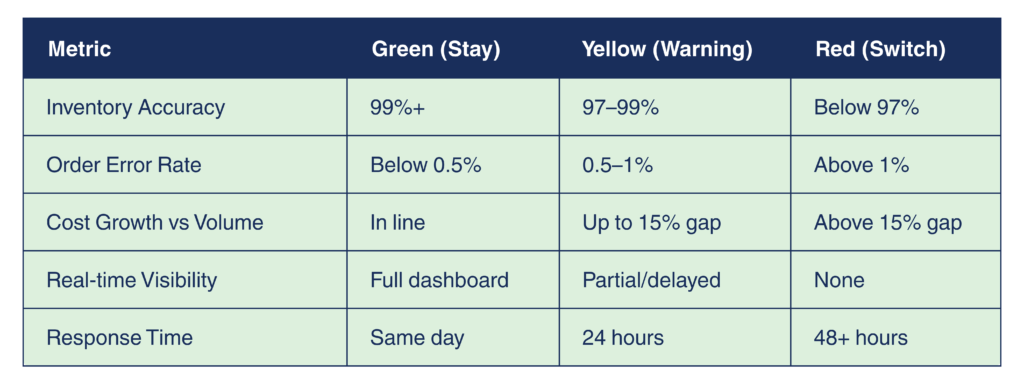
Two or more red flags = it’s time to switch. One red flag with no improvement after a direct conversation = start your search.

Before You Switch: Have the Conversation
Before you start the RFP process, have one direct conversation with your 3PL. Tell them exactly what the problems are and what your timeline is for seeing improvement. Use specific numbers, not “your accuracy is bad” but “your inventory accuracy was 97.3% last quarter and I need it at 99% within 60 days.”
Two things can happen: they fix it (great, you saved yourself a transition), or they don’t (now you know for certain it’s time, and you gave them a fair chance).
Document this conversation in writing. If you end up in a contract dispute during the transition, this documentation matters.
How to Switch Without Destroying Your Operations
Step 1: Start your search while you’re still with your current 3PL
Never tell your current 3PL you’re leaving until you have a signed contract with the new one. Give yourself 60–90 days for the search and onboarding process.
Step 2: Run parallel operations for 30 days
Don’t do a hard cutover. Send a portion of your inventory to the new 3PL first, ideally your slower-moving SKUs. Learn their system, build the relationship, and iron out the integration before you move your hero inventory.
Step 3: Negotiate the exit from your current contract
Most 3PL contracts have 30–90 day termination clauses. Read yours now. If you’re in a long-term contract, there’s often a performance clause, if they’re not hitting the metrics they promised, you may have grounds to exit early.
Step 4: Move inventory during your slowest week
Never transition 3PLs during peak season or a major promotion. Pick your slowest sales week of the quarter and move then. Build 4 weeks of safety stock before the move so a slow transition doesn’t create a stockout.
What to Look for in Your Next 3PL
Beyond the obvious (rates, location, volume capacity), here’s what I tell every client to negotiate into their next 3PL contract:
SLA with financial penalties — not credits, penalties — tied to inventory accuracy and order error rates.
Named account manager who is your single point of contact.
Real-time WMS access with inventory visibility by SKU and location.
Defined response time SLAs for operational issues (I recommend 4 hours for critical, 24 hours for standard).
30-day termination clause with no penalty if they miss SLA metrics two months in a row.
The 3PL that argues against financial penalties in an SLA is telling you something. A confident operation welcomes accountability. Push for it.
The Bottom Line
The right time to switch 3PLs is before the damage is done, not after you’ve absorbed months of errors, lost customers, and frustrated your team chasing down problems that shouldn’t exist.
Use the metrics above. Have the direct conversation. And if nothing changes in 60 days, start your search. A 3PL transition is stressful for about six weeks. Bad 3PL performance is stressful every single day.
Think the Problem Is Your 3PL?
Most DTC brands aren’t just with the wrong 3PL, they’re overpaying the wrong 3PL. I break down exactly how to audit your warehouse costs, renegotiate your contract, and recover margin hiding in storage fees, pick costs, and returns, including a real example that brought $42,360 back into the P&L.
Already know your bottleneck?
Join the Supply Chain Lounge on Slack where we discuss these exact challenges every week.