
Your Q4 inventory is being made right now. Here are the four mid-production checkpoints, how to structure milestone payments, and the 3 warning signs.
Short answer: Your Q4 inventory is no longer a decision. It is being made. The production phase is the longest stretch in the cycle and the least monitored, and it is the last point where a problem is cheap to fix. Four checkpoints, run on a rhythm, catch nearly everything.
Why is the production phase a blind spot?
Because there is nothing obvious to do. The purchase order is placed, the deposit has cleared, and the next checkpoint most founders hold in their head is final inspection. The weeks in between feel like waiting.
They are not waiting. They are the widest window you have for fixing something cheaply, and it closes the day the goods ship.
The economics are lopsided. A defect found mid-run is a conversation and a partial rework. The same defect found at final inspection is a reorder against a lead time you no longer have, which as of late August 2026 means missing Black Friday Cyber Monday entirely.
What should you check mid-run, and when?
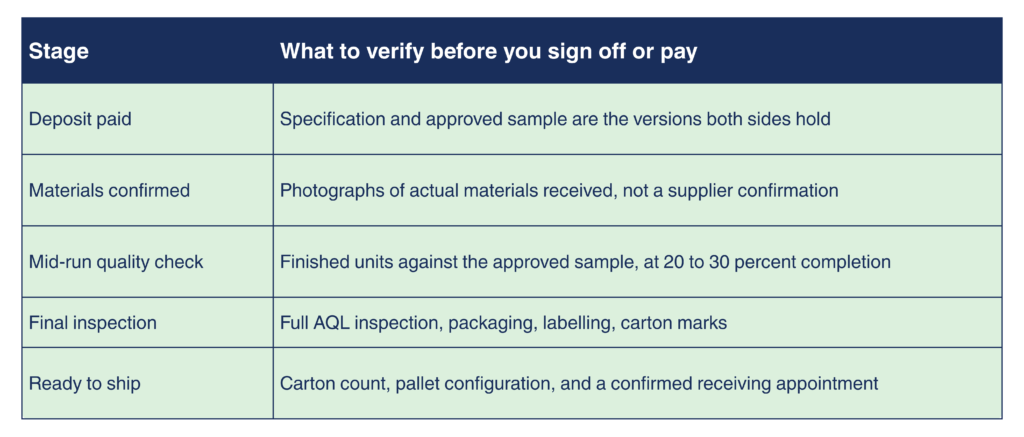
Run the mid-run check at roughly 20 to 30 percent completion, early enough that the remaining 70 percent can still be corrected.
Waiting until half the order is done halves the value of finding anything. The point of an inline check is not to catch defects. It is to catch them while most of the run is still ahead of you.
Ask for four things specifically.
Photographs of finished units next to the approved sample, in the same frame. Not units alone, and not a photo of the production line. The comparison is the check.
Measurements of the dimensions that matter for your product, taken from actual units, written down.
Photographs of the materials in use, so you can confirm the substitution conversation nobody had.
A count of units completed, which is your timeline check disguised as a quality check.
If your order is large enough or the SKU is high risk, a third-party inline inspection is worth the cost. Below that threshold, photographs against the approved sample catch most of what matters. Move Supply Chain runs a version of this for clients on a fixed rhythm, and the majority of what it surfaces is caught by photographs rather than by formal inspection.

When should you release a milestone payment to a supplier?
Release payment against verified progress, never against a date. A payment tied to a calendar entry is not a milestone.
This is the single most common structural weakness in a small brand’s purchase order, and it costs nothing to fix.
“Balance due at 50 percent completion” sounds like a milestone. It is not, because nobody has defined what 50 percent looks like or who confirms it. In practice it becomes a date, and the date arrives whether the units do or not.
“Balance due on receipt of photographs showing 2,000 finished units against the approved sample” is a milestone. It has one interpretation.
Rewrite your payment terms this way on the next purchase order. Good suppliers do not object, because good suppliers have the units and would rather be paid for verified work than argue about a date.
A supplier who pushes back hard on evidence-based payment terms is giving you real information about their capacity.
What does a factory visit catch that photographs cannot?
A visit verifies what you chose to look at. Photographs only ever verify what the supplier chose to show you.
That distinction is the whole limitation of remote monitoring, and it is worth being honest about it. Everything above works, and most brands should be doing all of it. But a photograph is a frame someone selected, taken at a moment someone selected, of a unit someone selected. Three layers of selection sit between you and the factory floor, and none of them are dishonest. They are just how photographs work.
Standing in the building removes all three.
What that catches, specifically:
Whether your order is being made where you think it is. Unauthorised subcontracting is one of the most common surprises in small-brand manufacturing, and it is close to invisible remotely. The photographs are real. The units are real. They were simply produced in a different facility by a workshop you have never assessed and cannot hold to anything.
What the line actually looks like when nobody is presenting it. Stated capacity and observed capacity are frequently different numbers. So are the stated headcount and the number of people working. You do not need to be an auditor to notice that a line quoted at three thousand units a day is running at half that.
The materials sitting in the store. A photograph of materials in use confirms one batch. Walking the material store tells you whether there is enough on site to finish your run, or whether a second purchase is still pending somewhere.
How you are treated once you have been in the room. This one is harder to quantify and it matters more than the rest. A supplier who has met you in person, walked you through their process, and eaten a meal with you responds differently to a difficult question six weeks later. That is not sentiment, it is how the relationship functions.
This is also why Move Supply Chain is going back to the factory floor in China and Vietnam in October 2026. Not as a content exercise. Supplier verification is the part of this work that does not translate fully to a screen, and the brands with the least guesswork in their supply chain are consistently the ones whose suppliers have been assessed in person by someone who knew what to look at.
If you already have a supplier you are uneasy about, that unease is usually worth a visit rather than another round of photographs.
What check-in rhythm actually works?
Agree a fixed weekly rhythm before production starts, rather than checking in reactively when something feels off.
Reactive check-ins make every message an event. Ask three times in two weeks and you start to feel like a difficult client, so you ask less often, which is precisely when you need the information most.
A scheduled update removes the judgement call. Every Tuesday, two photographs and a one-line status. That is the entire ask, and it takes a factory five minutes.
What changes is not the volume of information. It is that a missed update becomes immediately visible instead of being something you talk yourself out of chasing.
Put it in the purchase order confirmation as a single sentence. Establishing it before production starts costs nothing. Introducing it halfway through reads as suspicion.
Why confirm your fulfilment slot before goods are finished?
Because third-party logistics providers book receiving capacity in advance, and that capacity fills through September and October. A container arriving without an appointment waits, and demurrage accrues while it does.
Founders tend to file this under shipping and handle it when goods are ready to leave the factory. By that point the useful slots are gone.
Give your 3PL your expected arrival window, carton count, and pallet configuration now, while production is still running, and get the receiving appointment confirmed in writing.
If your dates move, and they often do, rescheduling an existing booking is considerably easier than creating one in October. This pairs directly with setting your shipping cadence, since a consolidated sailing arrives as one large receiving event rather than several small ones.
What are the signs a production run is going sideways?
Three, and the third is the one most founders misread.
- No photographs or substantive updates past your agreed check-in date. Not a late reply. A pattern of updates that describe status without showing anything.
- A milestone payment requested ahead of confirmed progress. A supplier asking to be paid early is sometimes a cash flow issue at their end, which becomes your timeline issue shortly afterwards.
- A supplier going quiet on a specific question they would normally answer same-day. This is the one that gets misread as everything being fine. A supplier who answers five questions quickly and then does not answer the sixth has told you which question is the problem. The silence is the answer.
None of these three means a run has failed. All three mean it is time to ask a direct question rather than wait for the next scheduled update.
What should you do this week?
Three things, in order.
Send one message to each supplier with a current order asking for photographs of units in progress against the approved sample. Not a status request. Photographs.
Look at how your next milestone payment is worded. If it references a date rather than a verifiable quantity, rewrite it before it comes due.
Call your 3PL and book the receiving appointment.
Frequently asked questions
When should a mid-production quality check happen?
At roughly 20 to 30 percent completion. Early enough that the remaining run can still be corrected. Checking at 50 percent halves the value of anything you find.
Should I pay a supplier based on dates or progress?
Progress, always, with the evidence specified in the purchase order. “Photographs showing 2,000 finished units” is a milestone. “50 percent completion” is a date with a milestone’s name on it.
How often should I check in with a factory during production?
Weekly, on a fixed day agreed before production starts. A scheduled rhythm removes the awkwardness of asking and makes a missed update immediately visible.
What if my supplier stops answering a specific question?
Treat it as a signal rather than an oversight, particularly if they are answering other questions promptly. Ask the question again directly and ask for a date by which you will have an answer.
Where to go from here
Three options, depending on how close to a problem you actually are.
If you want the checklist. The full checkpoint list, the one our managers run on a client’s behalf, is in the Comprehensive Manufacturer Audit SOP. Free, ungated, nothing to fill in. Take it, run it yourself, and you will catch most of what this article describes.
If something about your current run is not sitting right. Move Supply Chain runs a 7-day trial: one dedicated supply chain manager for a week, two live sessions, and a direct line in between. You leave with a documented action plan and a real number on what the problem is costing you. Free, no card. Capped at ten brands a month because it is genuine manager time, not a funnel. Fit is roughly $3M to $10M in revenue, actively placing or planning Q4 orders. Apply here.
If the supplier is the problem and you have known it for a while. We are on factory floors in China and Vietnam in October 2026. If your supplier is in either country, we can assess them in person while we are there: line capacity, material store, whether your order is actually being produced where you were told, and the questions that only get honest answers face to face. You get a written assessment and photographs you selected rather than photographs you were sent. Limited by geography and by calendar, so the sooner we know, the better the chance we can route to you. Tell us where your supplier is!
Most brands need the first one. A few need the second. If you have read this far because of a specific supplier you are worried about, it is probably the third.
Until next time,
— Lara
Your Production Is Running. Your Landed Cost Just Changed. Here’s What to Do With Both.
A cost increase stops being a supply chain problem after about 45 minutes — it becomes a cash flow problem, a promo problem, a merchandising problem, and a fulfillment problem that can ruin your Q4 if you ignore it. I walk through 3 operations moves and show how to distribute one updated landed cost number across Finance, Marketing, Merchandising, CX, and your 3PL before it quietly erodes your peak season margin.
Already know your bottleneck?
Join the Supply Chain Lounge on Slack where we discuss these exact challenges every week.