
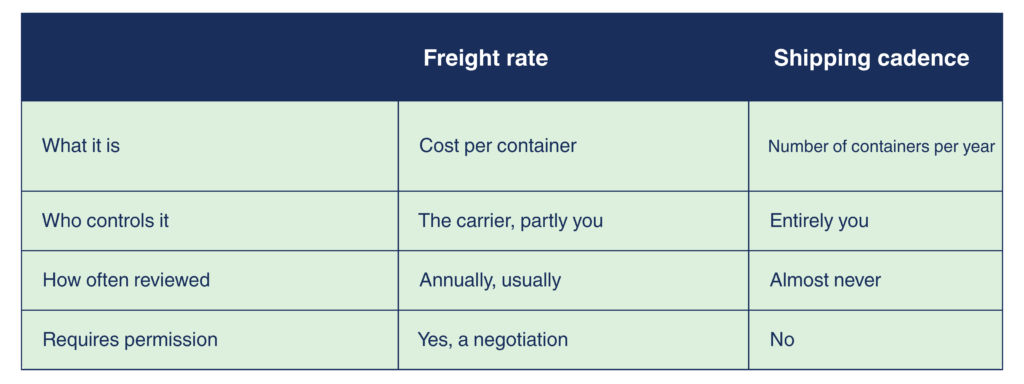
Your freight bill is a rate multiplied by the number of times you ship. Most brands negotiate the rate every year and have never revisited the cadence. Fixing cadence is free, requires nobody’s permission, and usually moves more money than a rate reduction does.
Your freight bill is a rate multiplied by how often you ship. Here’s how to set cadence, consolidate POs, and lock a rate cap before peak pricing lands.
Why does shipping cadence matter more than the rate?
Because a rate is a per-shipment cost, and cadence decides how many shipments you have. A ten percent rate reduction saves ten percent. Moving from twenty-six sailings a year to seventeen changes the multiplier.
Both are worth doing. Only one of them requires negotiation.
The reason cadence goes unexamined is that it was never really chosen. In year one, goods were ready, a forwarder quoted, the shipment went, and that rhythm became the default. Four years later it’s still running, and nobody can point to the decision that set it.
How do you work out your real cadence?
Start from sell-through, not from production readiness. Divide annual unit volume by the units a container holds, then space those shipments across the year against your demand curve rather than against your factory’s output schedule.
Most brands ship when goods are finished. That’s a factory-led cadence, and it produces shipments that arrive at inconvenient times and cost more than they need to.
A demand-led cadence works backwards. If a SKU sells 400 units a week and a container holds 5,000, that’s roughly a twelve-week supply per container, which means four or five sailings a year for that SKU, not twelve.
The gap between the two is usually where the money is. Move Supply Chain finds most brands under fifteen million are shipping meaningfully more often than their sell-through requires, purely because production timing rather than demand timing has been setting the schedule.

Which POs should travel together?
Consolidate when two or more POs are ready within roughly three weeks of each other and neither is urgent enough that the delay causes a stockout. Do not consolidate when waiting would push arrival past a demand spike.
The test is simple. For the PO that would have to wait, calculate how many days of cover you have on that SKU at current sell-through. If the wait is shorter than your cover minus your safety buffer, consolidate. If it isn’t, ship separately and accept the cost.
There is one case where consolidating loses money, and it’s the one people miss: consolidating into a full container that isn’t actually full. A forty-foot container at sixty percent utilisation costs the same as one at ninety-five percent. If combining two POs still leaves you well short of a full load, less-than-container-load shipping on both may genuinely be cheaper.
Check utilisation before you consolidate, not after.
How do you get a freight rate cap for peak?
Ask your forwarder for a rate agreement covering a defined window with a stated ceiling, backed by a volume commitment you can realistically meet. This is a different conversation from asking for a quote.
Timing matters more than most founders expect. Peak arrived early in 2026: in the first week of June, transpacific spot rates to the United States West Coast rose more than fifty percent in a single week, to roughly $4,800 per forty-foot equivalent unit, and the National Retail Federation moved its projected peak import month from July to June. Rates have stayed elevated and difficult to predict since.
What that means practically is that the leverage available in August is not the leverage available in late September. Carriers price against their own forward book, and that book fills.
Before the call, have three things ready: the number of containers you’ll actually move between now and January, your lanes, and your rough sailing dates.
Use the realistic volume figure, not the optimistic one. A commitment you miss carries shortfall penalties that can wipe out the entire saving from the cap.
What should you ask a freight forwarder?
Four questions, and the fourth is the one most founders forget.
- What ceiling can you hold through January, and at what volume commitment?
- What happens if I miss the commitment? Ask for the specific penalty structure, not a reassurance.
- What exactly does the rate cover? Confirm whether terminal handling, documentation, and peak season surcharges sit inside or outside the number.
- If spot rates fall below my cap, do I pay the cap or the market?
That last one separates a good agreement from an expensive one. A cap protects you on the way up and can strand you above market on the way down. Some forwarders will negotiate a floor-and-ceiling band rather than a hard cap. You won’t find out unless you ask directly.
Get all four answers in writing. A verbal cap is not a cap.
What should you do this week?
Three things, in this order, and all three fit in an afternoon.
Pull your last twelve months of sailings and count them. Most founders do not know this number and are surprised by it.
Calculate the demand-led cadence for your top five SKUs by revenue and compare it to what you actually ran.
Book the forwarder call. Not to ask about rates. To ask the four questions above with your volume number in hand.
Frequently asked questions
How often should a DTC brand ship inventory?
As often as sell-through requires and no more. Divide annual unit volume by container capacity, then space shipments against your demand curve. Most brands under fifteen million ship more frequently than needed because production timing, not demand timing, is setting the schedule.
Is a freight rate lock worth it?
Usually yes during a volatile peak, provided the volume commitment is realistic and you’ve asked what happens if spot falls below the cap. A cap you can’t meet the volume on costs more than no cap at all.
When should I negotiate peak season freight rates?
Before the carrier’s forward book fills, which in 2026 means considerably earlier than usual. Peak import volume moved from July to June this year, so August negotiating leverage is weaker than it would have been in a normal year and late September will be weaker still.
Does consolidating shipments always save money?
No. Consolidating into a container that still isn’t full costs the same as a full one. If combining two purchase orders leaves you well under capacity, less-than-container-load on both can be cheaper. Check utilisation before deciding.
Where to go from here
Most of what determines how that forwarder call goes is knowing what they know. The Freight Forwarder Secrets guide covers what sits on their side of the table: get it here.
Capping your freight rate is move seven in the operations playbook, and it’s the only one on that list with a deadline attached.
And if the reason your cadence has never been revisited is that only one person in the business could change it, that’s a different problem. Michael E. Gerber and Lara Guevara are covering it in a free session on August 20: details here.

And for brands where the real constraint is not the calculation but the fact that only one person in the business can make any of these decisions, Move Supply Chain is hosting a free session with Michael E. Gerber on August 20 on exactly that problem: the eight roles inside every business and why most founders end up holding all of them at once.
Until next time,
— Lara
Think Your Landed Cost Is Accurate? It Might Not Be.
The July 24 tariff reset (four separate changes, including Section 122 expiring and Section 301 phasing in) means the number you priced against in March is no longer true. I walk through the 5-step framework to recalculate landed cost in 15 minutes, how to check for 2025 duty refunds, and how to distribute the updated number across Finance, Marketing, Merchandising, CX, and your 3PL.
Already know your bottleneck?
Join the Supply Chain Lounge on Slack where we discuss these exact challenges every week.