

The formula DTC founders get wrong, and the real number that kills your margin
Landed cost is the total cost to get your product from your supplier’s factory to your warehouse door. Not just the product price. Everything. And in my 17 years of supply chain, I’ve never met a DTC founder who calculated it correctly the first time.
Here’s why it matters: if you’re pricing your products based on FOB cost alone, you’re probably underpricing by 15–40%. That gap is where margin goes to die.
Landed Cost = FOB Cost + International Freight + Customs Duties + Insurance + Port & Drayage Fees + Last-Mile to Warehouse
Let me break down each component, and more importantly, tell you what founders consistently miss inside each one.
Breaking Down Each Cost Component
1. FOB Cost (Free On Board)
This is what your supplier quotes you. It covers manufacturing plus getting the product to the port of origin. Most founders think this is the hard part. It’s actually the easiest number to get right.
What founders miss: Price breaks at MOQ thresholds can make your FOB cost look great, until the landed cost math shows you ordered 4 months more inventory than your cash flow can handle.
2. International Freight
Ocean freight for a 20ft container from China to the US West Coast currently runs $1,500–$4,000 in stable conditions. Air freight is 4–6x more expensive but takes 5–7 days vs 25–35 days by sea.
Rule of thumb: if your product weighs less than 0.5kg per unit and has high velocity, run the air vs ocean math every quarter. The speed-to-shelf difference sometimes justifies the cost.
What founders miss: Fuel surcharges, peak season premiums (Q3-Q4 can spike freight 40–80%), and the difference between CIF (supplier arranges freight) and FOB (you arrange freight) pricing.
3. Customs Duties & Tariffs
Duties are calculated as a percentage of the FOB value and vary by HTS code (the product classification). Most apparel sits at 12–32%. Electronics can be 0–25%. Food and supplements have their own complex rules.
With current tariff conditions, this line item has become the most volatile in the landed cost calculation. A 10% tariff increase on a $20 FOB item is $2/unit, which is $20,000 on a 10,000-unit order.
What founders miss: First Sale Valuation, a legal method that can reduce your dutiable value if you’re buying through an intermediary. Most founders leave this money on the table.
4. Insurance
Cargo insurance typically runs 0.3-0.5% of the shipment value. For a $100,000 shipment, that’s $300–$500. Skip it once, lose a container, and you’ll never skip it again.
What founders miss: Standard carrier liability is NOT the same as cargo insurance. Most carriers limit liability to $500-$2,000 per shipment regardless of actual value.
5. Port & Drayage Fees
These are the costs to move your container from the port to your 3PL or warehouse. Port fees, chassis fees, and terminal handling. These add up to $300–$800 per container and are consistently underestimated.
What founders miss: Detention and demurrage fees. If your container sits at the port beyond the free time (usually 3-5 days), fees start at $150/day and escalate fast.
6. Last-Mile to Warehouse
Trucking from port to your 3PL. Varies dramatically by distance and market, $200 locally, $800+ for cross-country drayage.
The Landed Cost Formula in Action
Here’s a real example. A brand importing a $12 FOB skincare product:
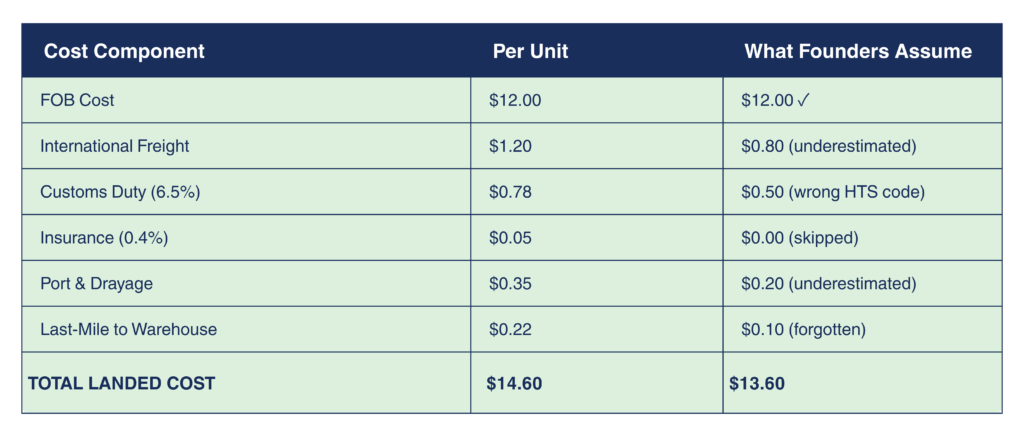
That $1/unit gap doesn’t sound like much. On 10,000 units it’s $10,000. On 100,000 units it’s $100,000, and that’s a pricing mistake that erodes margin all year.
3 Landed Cost Mistakes I See Every Week
Mistake 1: Using FOB Cost for Margin Calculations
I worked with a $4M apparel brand that was pricing products at 65% gross margin based on FOB. When we calculated landed cost properly, their actual margin was 51%. They had been underpricing for 18 months.
Mistake 2: Not Updating Landed Cost When Freight Markets Move
Freight rates can move 30–50% in a quarter during volatile periods. If you locked in your pricing 6 months ago based on old freight rates and haven’t updated your landed cost model, you’re flying blind.
Mistake 3: Ignoring Tariff Classification
The HTS code you use determines your duty rate. Many founders use a code that’s close but not precise, and pay higher duties than required. A customs broker audit has paid for itself in savings for every client I’ve recommended it to.
How to Calculate Landed Cost Right Now
Step 1: Get your freight forwarder to break out every fee line by line. Not a flat rate, every line.
Step 2: Pull your HTS code and verify the duty rate at usitc.gov. Cross-check it with your customs broker.
Step 3: Build a simple spreadsheet with the 6 components above. Update it every quarter or when freight markets move significantly.
Step 4: Price every product off landed cost, not FOB. Your target margin applies to the full cost to get the product to your door.
The MOVE benchmark: landed cost should be no more than 25–35% of your retail price for a healthy DTC margin. If it’s higher, you either have a pricing problem or a sourcing problem, and they require different fixes.
The Bottom Line
Landed cost isn’t complicated. But it requires discipline, the discipline to calculate every component, update it regularly, and price off the real number instead of the comfortable one.
Every DTC brand I’ve worked with that had a margin problem had a landed cost calculation problem underneath it. Fix the number first. Everything else follows.
Want to Stop Losing Margin on Every Shipment?
I walk through the exact landed cost formula, break down every fee line your freight forwarder isn’t telling you about, and show you how to price off the real number, not the comfortable one.
Already know your bottleneck?
Join the Supply Chain Lounge on Slack where we discuss these exact challenges every week.