
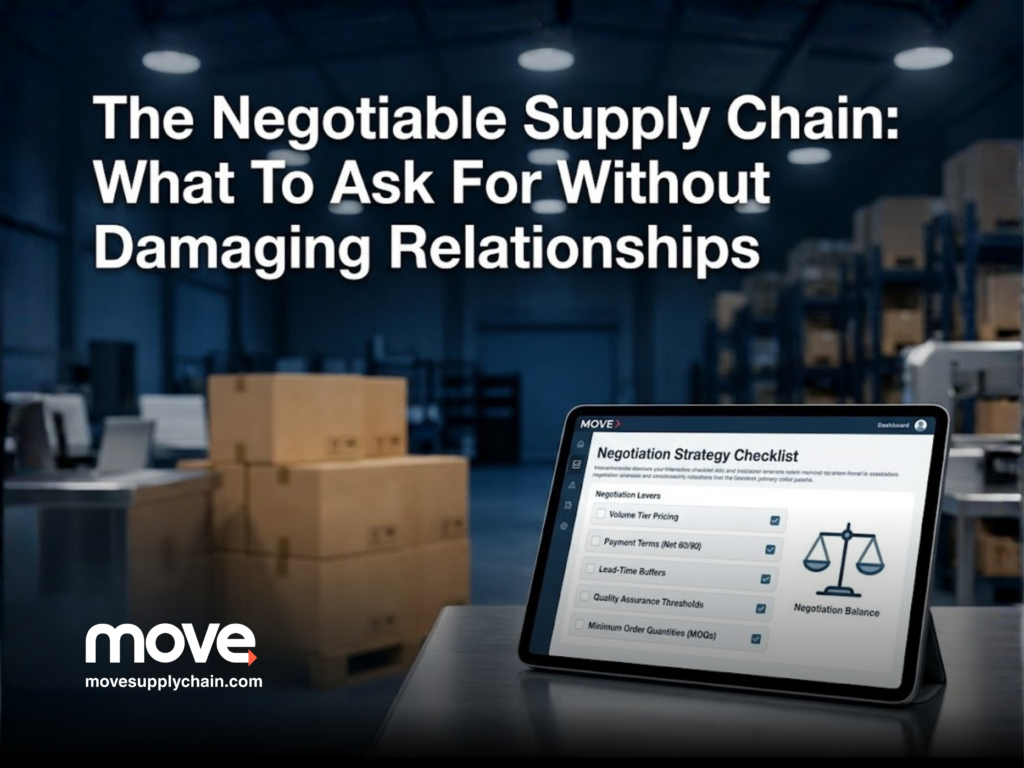
Most DTC founders accept the first supplier offer because they don’t know what’s on the table. Learn the 7 negotiable items, how to frame requests collaboratively, and when to push versus accept—with scripts you can use today.
Most founders accept the first offer from suppliers.
Not because they can’t negotiate. Because they don’t know what’s negotiable.
In 17 years of supply chain work—from enterprise to DTC—I’ve learned that almost everything is on the table if you know how to ask. Payment terms, MOQs, sampling costs, lead times, quality thresholds, packaging specs, shipping arrangements. The supplier’s first quote isn’t a final answer. It’s a conversation starter.
This week, we’re getting tactical. What’s actually negotiable, how to ask without damaging relationships, and when to push versus when to accept.
The 7 Negotiable Items Most Founders Miss
1. Payment Terms
Net 30 isn’t law. It’s a default starting point. You can negotiate Net 45 or Net 60. You can negotiate lower deposits—moving from 50% upfront to 30%. You can negotiate payment timing—before shipping versus after delivery.
The cash flow impact of payment terms often exceeds the value of a price discount. A $50,000 order with Net 60 instead of Net 30 means $50,000 in your account for 30 extra days. That capital can fund ads, cover payroll, or bridge cash gaps.
2. MOQs (Minimum Order Quantities)
The stated MOQ is a preference, not a rule. Suppliers set high minimums to filter out tire-kickers and ensure profitable production runs. But for first orders, test runs, or established customers? There’s almost always wiggle room.
The magic question: “We’re interested in testing this product. What would a smaller first order look like?”
3. Sampling Costs
Some suppliers charge $500+ for samples. Others waive sampling costs entirely for serious buyers. The difference is often just asking: “Is there flexibility on sampling if we move forward with production?”
4. Lead Times
Quoted lead times often include buffer for the supplier’s protection. Ask: “What would it take to reduce this by a week?” Sometimes the answer is priority scheduling, which costs nothing. Sometimes there’s a small rush fee that’s worth paying.
5. Quality Thresholds
What’s the acceptable defect rate? What happens when it’s exceeded? Who pays for remediation? These terms protect you, and they should be discussed and documented before problems occur.
6. Packaging Specs
Carton sizes, inner packaging, labeling—all affect your DIM weight and fulfillment costs. Ask: “Can we adjust packaging to reduce shipping costs?” A smaller carton might save you thousands annually.
7. Shipping Arrangements
FOB, CIF, DDP—who pays for what matters. The default Incoterms aren’t always the best option for your business. Ask to discuss shipping options and understand what each means for cost and risk allocation.
The Finance Connection: Why Payment Terms Might Matter More Than Price
Here’s the negotiation lever most founders ignore: payment terms.
Everyone fights for a lower unit price. But the real cash flow impact often comes from when you pay, not how much.
Example: $50,000 order
Option A: 5% price discount = $2,500 saved
Option B: Net 30 → Net 60 = $50,000 in your account for 30 extra days
For a cash-constrained DTC brand, those 30 extra days might be worth far more than $2,500.
This is why Finance and Supply Chain need to talk before negotiations. Finance can model the actual cash flow impact of different term structures. Sometimes the price discount wins. Sometimes the payment terms win. You need the math to know.
How to Ask Without Damaging the Relationship
HOW you ask matters as much as WHAT you ask. Here are five principles that preserve relationships while getting better terms:
1. Frame as Partnership: “How can we structure this so it works for both of us long-term?” beats “I need you to lower your price.”
2. Give Context: “We’re testing this market” justifies a lower MOQ. Context makes asks reasonable.
3. Use Open Questions: “What flexibility do you have on lead time?” opens doors. “Can you do it faster?” closes them.
4. Trade, Don’t Take: “If we commit to 3 orders this year, what terms can we lock in?” Value exchange feels fair.
5. Know When to Stop: Push too hard and you damage trust. Good negotiation leaves both parties respected.
A Script You Can Use Today
Here’s the exact script I use to open payment term negotiations:
“Hi [Name], As we continue working together, I’d like to discuss our payment structure. We’re committed to this partnership long-term, and we’d like to explore whether there’s flexibility to extend our payment terms from Net 30 to Net 45 or Net 60. This would help us manage cash flow as we scale, and we’re happy to discuss what we can offer in return—whether that’s volume commitments, longer-term forecasts, or faster payment on a portion of orders. Would you be open to discussing this?”
Why this works: It signals long-term thinking, gives context, offers value exchange, and opens conversation rather than demanding.
When to Push vs. When to Accept
Push when: You’re a strong customer, have alternatives, your ask is reasonable, and you’re willing to trade value.
Accept when: You’re new, you need them more, terms are fair, or pushing would damage critical trust.
The goal isn’t to win every negotiation. The goal is to build a supplier relationship that serves you for years.
The Bottom Line
The best supplier negotiations don’t feel like negotiations. They feel like two partners figuring out how to work together.
Next week: The Supplier Agreement You Should Have Signed Six Months Ago—because verbal agreements and WeChat threads aren’t enough.
Already know your bottleneck?
Join the Supply Chain Lounge on Slack where we discuss these exact challenges every week.