
Why the textbook formula fails DTC brands, and the version that actually works
Every inventory planning article on the internet gives you the same safety stock formula. And for most DTC brands, it’s wrong. Not because the math is bad because it was built for stable, predictable supply chains. Yours isn’t one of them.
Here’s the standard formula you’ve probably seen:
Safety Stock = Z-score × σ(demand) × √Lead Time
The problem: this formula assumes your lead time and demand variability are independent. For DTC brands sourcing from overseas suppliers, they’re not. When demand spikes, lead times often spike too — because every other brand is placing emergency orders at the same time.
In my 17 years of supply chain, I’ve seen brands run out of stock using this formula correctly. Let me show you what actually works.
Why the Standard Formula Fails DTC Brands
Problem 1: It Doesn’t Account for Lead Time Variability
If your supplier says lead time is 45 days but it’s actually 35–65 days depending on their production load, your safety stock calculation is based on a fiction. The standard formula uses a fixed lead time. The DTC version needs to account for the range.
Problem 2: It Treats All SKUs the Same
Your hero SKU — the one that drives 40% of revenue — needs different safety stock logic than your slow-moving variants. A stockout on your hero costs you customers, reviews, and algorithm ranking. A stockout on a slow SKU costs you almost nothing.
Problem 3: It Ignores Supplier-Specific Risk
A supplier who’s delivered on time 19 of the last 20 orders needs different safety stock than one who’s hit their window 12 of 20 times. Same formula, wildly different risk profiles.
The DTC Safety Stock Formula
Here’s the version I use with every Move Supply Chain client:
Safety Stock = (Max Daily Sales × Max Lead Time) − (Avg Daily Sales × Avg Lead Time)
This is the min-max method, and it works better for DTC because it uses your actual observed extremes instead of statistical assumptions.

How to calculate it — step by step:
Step 1: Max Daily Sales: Look at your last 90 days of sales. What was your single highest sales day? That’s your max.
Step 2: Max Lead Time: Look at your last 10 orders from this supplier. What was the longest lead time? That’s your max.
Step 3: Average Daily Sales: Sum of last 90 days ÷ 90. Simple.
Step 4: Average Lead Time: Sum of your last 10 lead times ÷ 10.
Step 5: Run the formula. The result is your safety stock in units.
A Real Example
A $6M DTC supplement brand, hero SKU:
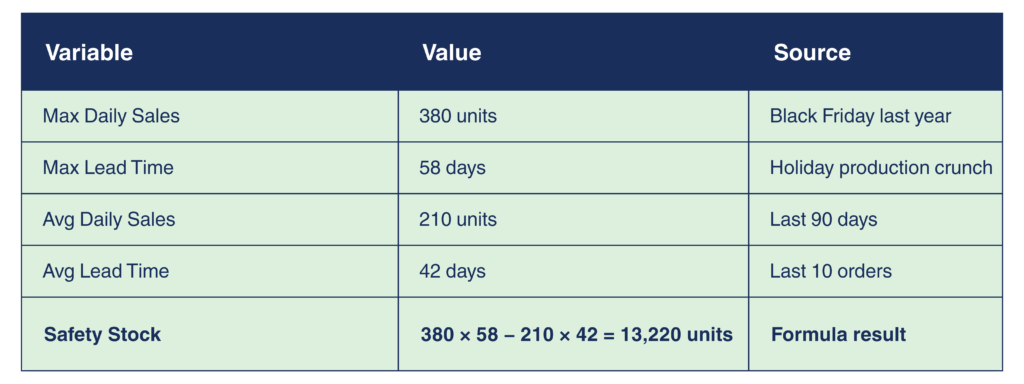
13,220 units of safety stock. At $4.20 COGS, that’s $55,524 in working capital sitting as buffer. Is it worth it? For a hero SKU driving $240K/month in revenue, absolutely. For a slow variant doing $8K/month, not even close.
The Risk Multiplier: Adjusting for Supplier Reliability
Once you have your base safety stock number, adjust it by supplier performance:
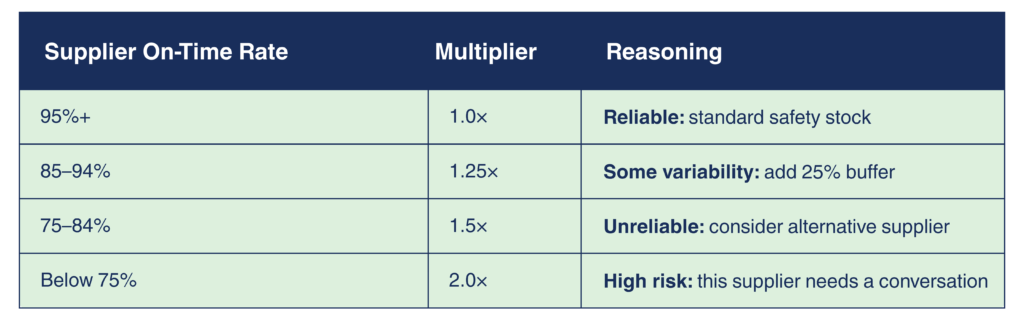
If your supplier multiplier is consistently above 1.5×, you don’t have a safety stock problem. You have a supplier problem. Fix the root cause.
Hero SKU vs. Long Tail: Different Rules
Not all SKUs deserve the same safety stock investment. Here’s the framework I use:
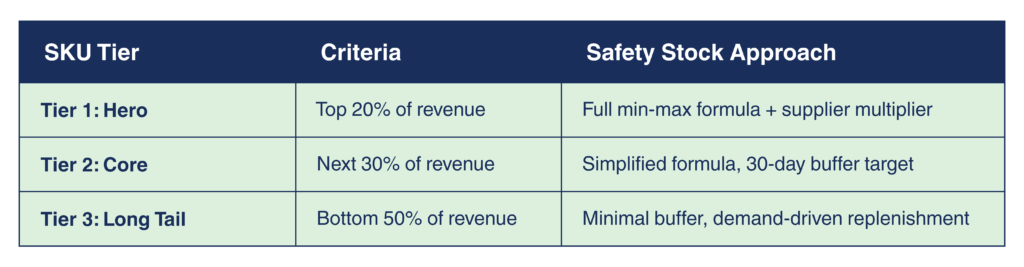
Most brands I work with are over-stocking Tier 3 and under-stocking Tier 1. The fix is simple: run the calculation by tier, not uniformly across your catalog.
How to Implement This Week
Pull your last 90 days of daily sales data by SKU from your Shopify or ERP.
2. Pull your last 10 purchase orders and calculate actual vs. promised lead times per supplier.
3. Identify your Tier 1 SKUs (top 20% of revenue).
4. Run the min-max formula for each Tier 1 SKU.
5. Apply the supplier reliability multiplier.
6. Compare your current inventory to the safety stock target. The gap is your reorder trigger.
If your supplier multiplier is consistently above 1.5×, you don’t have a safety stock problem. You have a supplier problem. Fix the root cause.
The Bottom Line
The textbook safety stock formula was built for predictable, stable supply chains. DTC isn’t that. Use the min-max method, segment by SKU tier, adjust for supplier reliability, and update your numbers every quarter when your lead time data refreshes.
A stockout on your hero SKU during peak season costs you more than just the lost sale. It costs you reviews, ranking, and the customers who found a competitor and liked them. Safety stock is cheap insurance against that scenario.
Think Safety Stock Is Your Only Problem?
The real issue is whether your supply chain can absorb disruption without breaking your cash flow, your timelines, or your team. I break down the 4 pillars of supply chain agility, including how much safety stock is actually right for your stage, in this 26-minute deep-dive built on 17 years of DTC supply chain experience.
Already know your bottleneck?
Join the Supply Chain Lounge on Slack where we discuss these exact challenges every week.